
Product · Product Update / Platform Expansion · 14 min
MentionX expands from five to ten AI platforms — Google AI Overviews, AI Mode, Copilot, Meta AI and DeepSeek join the original desk for cross-platform visibility.
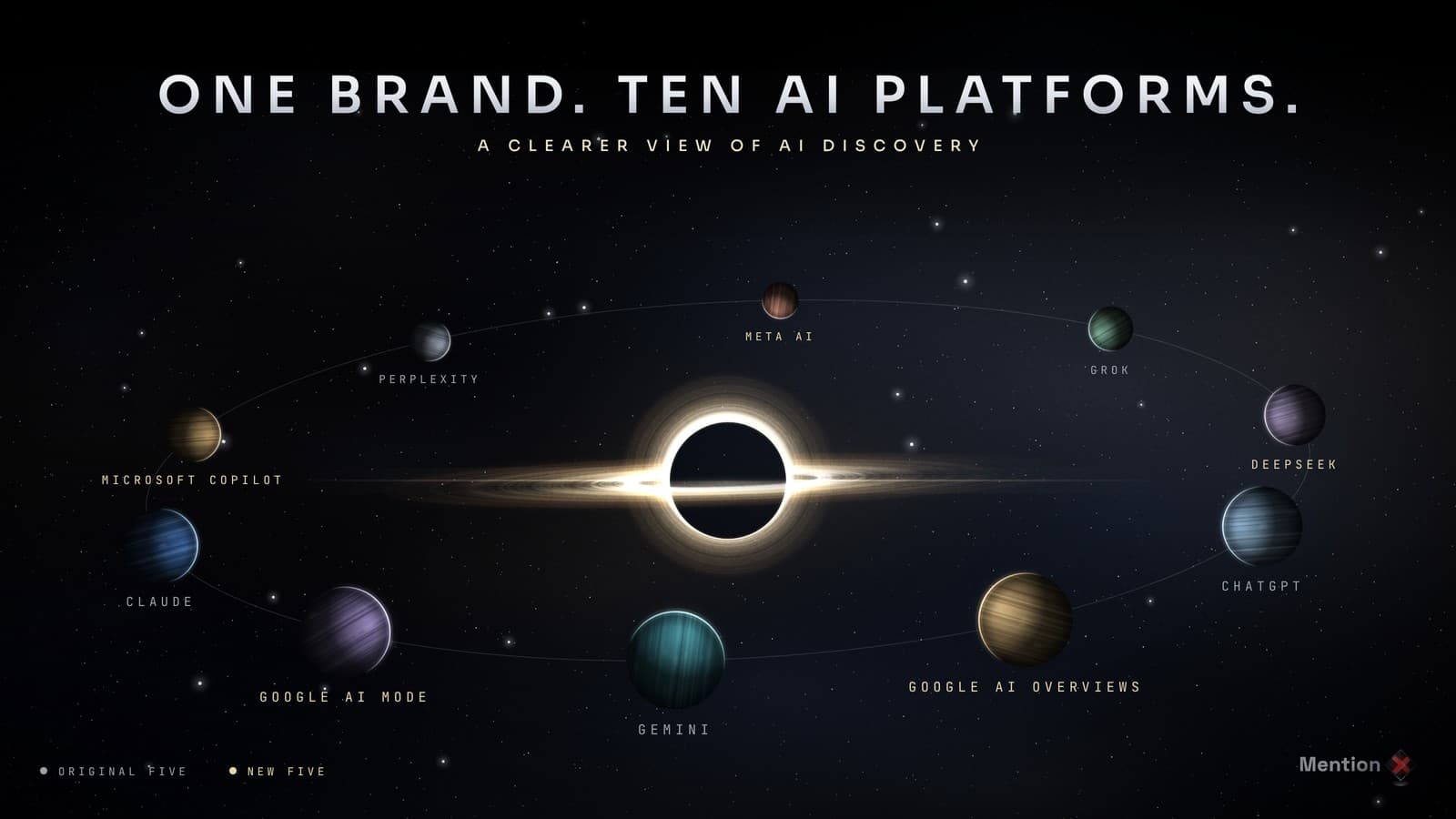
Five was never supposed to be the finish line.
When we launched MentionX, we started with ChatGPT, Gemini, Claude, Perplexity and Grok. Together, they gave brands a useful starting point for understanding how they appeared in AI-generated answers.
But the more buyer questions we analysed, the clearer the limitation became.
A brand could be recommended by ChatGPT and completely absent from Gemini. A competitor could dominate Perplexity because of the sources it cited, yet barely appear in Claude. Grok could introduce another set of brands altogether.
Looking at one platform was not enough. Even looking at five left important parts of the buyer journey unmeasured.
Today, MentionX expands from five to ten AI platforms and search experiences.
We have added:
They join:
This is a major product expansion, but the number itself is not the point.
The real value is being able to see how your brand performs across the places where people are now researching problems, comparing vendors and asking for recommendations.
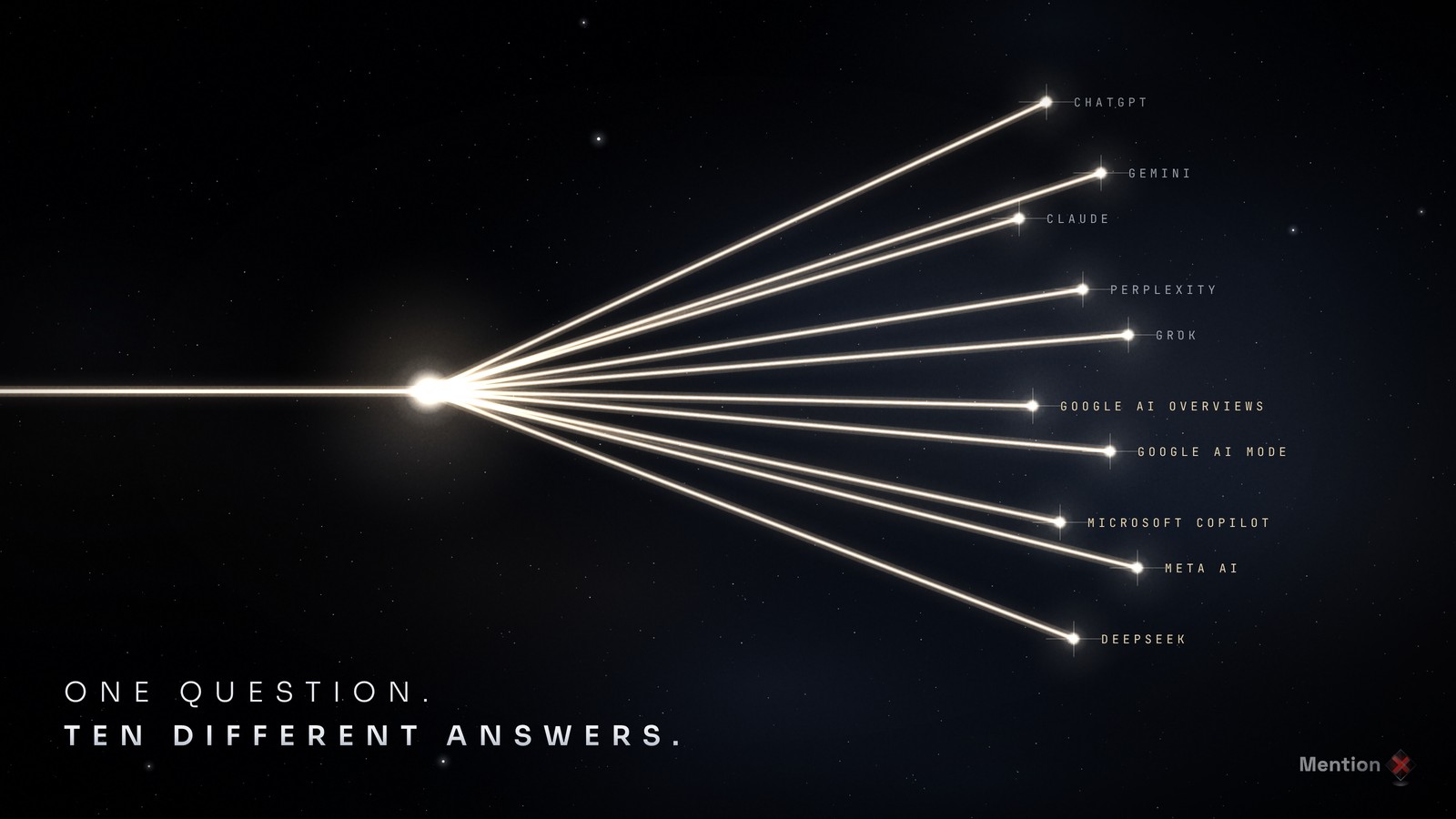
There is no single AI result page.
Ask ten AI platforms the same question and you may receive ten different answers. Some will mention your brand. Some will recommend it. Others will cite a competitor or rely on sources that barely acknowledge your existence.
That variation is not an edge case. It comes from genuine differences between platforms.
Each platform uses its own models, retrieval systems, search indexes, source-selection methods and response formats. Some rely heavily on current web results. Others lean more on model knowledge. Location, wording, buyer context and follow-up questions can also change the final answer.
Consider a question such as:
What are the best compliance platforms for a global company?
One platform may produce a ranked shortlist. Another may explain the category without recommending anyone. A third might name several established vendors but leave out a newer specialist entirely.
None of those individual answers represents the whole market.
This is why AI visibility cannot be treated like a traditional keyword ranking. There is no permanent number-one position. What matters is the pattern across platforms, buyer questions, competitors and time.
Buyers have not stopped using search. Search has simply spread into more places.
An answer may now appear at the top of a Google results page, inside a dedicated conversational search experience, through an AI assistant, or in an app that someone already uses every day.
Google describes AI Overviews as a core Search feature, while AI Mode offers a more conversational way to explore complex questions. Google also explains that these experiences may use “query fan-out,” running multiple related searches across subtopics and data sources before forming an answer. (Google Search Central — AI features and your website)
Microsoft combines generative answers with Bing search through Copilot Search, presenting summarised information alongside supporting sources. (Microsoft — Copilot Search)
Meta AI brings web-connected assistance into products including WhatsApp, Instagram, Facebook and Messenger, placing recommendations closer to everyday conversations. (Meta — Meta AI)
DeepSeek also provides web search through its official app and web experience, giving users another way to research current topics and evaluate options. (DeepSeek)
These are not identical products. Google AI Overviews and AI Mode are search experiences rather than standalone foundation models. Copilot, Meta AI and DeepSeek have their own interfaces, retrieval behaviour and use cases.
From a brand’s perspective, however, they all create the same strategic question:
When someone asks about our market, do we appear in the answer?
We did not add five more names simply to make the platform list longer. Each one represents a distinct part of the changing discovery journey.
AI Overviews place generated answers directly within Google Search.
This matters because a company can still rank organically while being absent from the answer that appears above or around those traditional results. Monitoring only blue-link rankings may therefore miss the first information a buyer sees.
Tracking AI Overviews helps brands understand whether Google’s generated response mentions them, recommends them or relies on sources that support their competitors.
AI Mode is built for deeper, conversational research.
Instead of entering one query and reviewing a list of pages, users can ask follow-up questions, refine their needs and move from broad discovery into detailed comparison.
A brand may appear during the first question and disappear when the buyer becomes more specific. The opposite can also happen. A specialist brand may be absent from a broad category answer but become highly relevant when the buyer adds an industry, company size or use case.
That journey needs to be measured separately.
Copilot brings AI-assisted discovery into the wider Microsoft and Bing ecosystem.
Its use of web grounding makes source visibility especially important. It is not enough to know whether a brand was mentioned. Teams also need to understand which pages and third-party domains helped shape the answer.
This creates a direct connection between SEO, digital PR, content authority and AI visibility.
Meta AI introduces a different discovery context.
People do not always begin product research with a formal search query. Recommendations can emerge during conversations, content discovery and interactions inside apps such as WhatsApp, Instagram, Facebook and Messenger.
That does not mean every social interaction has become a buying journey. It does mean that AI-assisted discovery is moving closer to the places where people already spend time, exchange opinions and ask informal questions.
For many consumer brands, local businesses and increasingly B2B companies, that surface cannot be ignored.
DeepSeek gives us another important view of how different models and retrieval systems interpret the same market.
It may identify different competitors, trust different sources or frame a category differently from Western AI platforms. For companies operating internationally, that variation is valuable intelligence rather than noise.
Adding DeepSeek allows teams to see whether their visibility is broadly consistent or concentrated within only a few AI ecosystems.
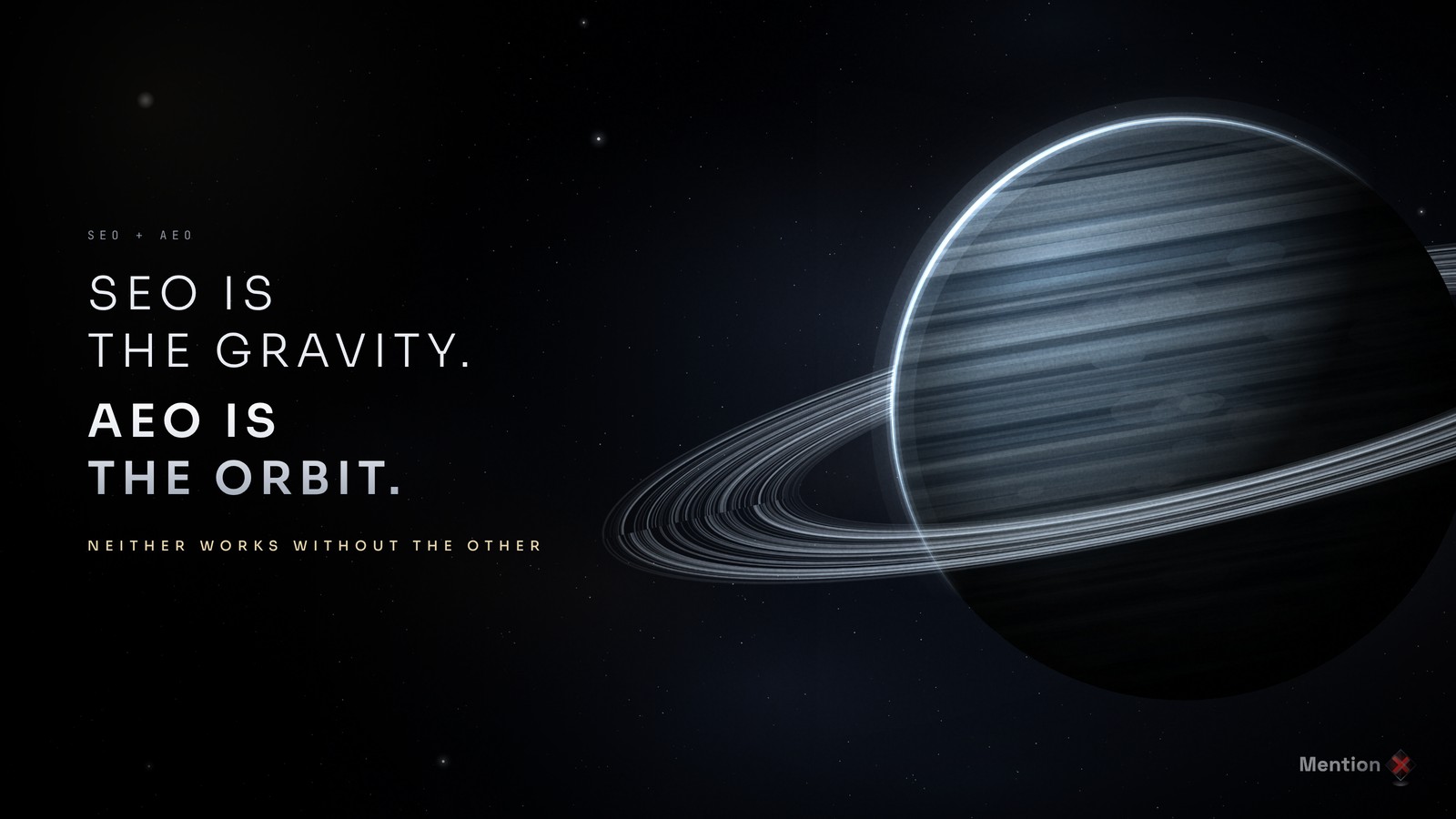
There is a strange idea circulating that AEO has replaced SEO.
It has not.
Google’s own guidance states that established SEO practices remain relevant to AI Overviews and AI Mode. It also confirms that publicly accessible, crawlable content remains important for visibility in its generative search features. (Google Search Central — AI features and your website)
If search engines cannot reliably crawl, understand and index your website, adding a few paragraphs written for AI will not solve the underlying problem.
Technical SEO still matters:
AEO adds another layer.
It asks whether an answer system can clearly identify what your company does, who it serves, where it is relevant and why it should be considered alongside competitors.
That requires more than inserting questions into headings.
Strong AEO content usually makes important information easy to locate and verify. It defines the category clearly. It answers specific buyer questions. It provides evidence. It avoids vague claims that could describe any company in the market.
Structured data can help machines interpret a page, but schema is not a shortcut to being recommended. An Organization block cannot compensate for an unclear product, weak content or contradictory information across the web.
Third-party evidence matters as well.
Review platforms, industry publications, comparison pages, communities and independent research can all contribute to how a brand is understood. Your website tells AI systems what you claim. The wider web helps them judge whether that claim is supported.
This is where SEO, AEO, digital PR and brand consistency begin to overlap.
For every tracked buyer question, teams can now compare responses across ten AI platforms and search experiences from one place.
MentionX shows:
This distinction between a mention and a recommendation is important.
A passing reference does not mean your brand made the shortlist. An AI answer might mention your company as background, include it in a long list or discuss it without suggesting that the buyer should consider it.
MentionX measures Recommendation Rate separately so teams can see the difference between being known and being chosen.
The broader platform coverage also makes aggregate visibility more meaningful. A strong result on one engine can no longer hide major gaps elsewhere. Teams can open the evidence, inspect the actual answers and understand what is driving the score.
The expansion creates five immediate advantages.
You can identify platforms where your brand is missing even when it performs well elsewhere.
You can see which competitors appear consistently across the market and which ones are strong only within a particular platform.
Instead of chasing every possible citation, you can focus on the sources that repeatedly influence answers within the platforms and buyer questions that matter.
If your brand is absent from high-intent comparison questions, that points to a different problem than being absent from early educational questions. The required content, evidence and distribution strategy will also be different.
Leadership does not need another collection of screenshots from manually tested prompts. It needs a repeatable view of where the brand appears, where it loses and whether that position is improving.

The goal is not to chase every answer produced by every model.
AI responses change. Prompts change. Models change. Trying to optimise for one isolated output will create a lot of activity and very little durable progress.
A better process starts with the buyer.
Build a balanced set of questions covering the real journey:
Run those questions consistently across relevant platforms. Then look for patterns.
Is your brand repeatedly absent from comparison prompts? Are you mentioned but rarely recommended? Does one competitor dominate because it has stronger third-party validation? Are AI systems relying on outdated pages? Is your visibility strong in ChatGPT but weak across Google’s AI search experiences?
Once the gap is clear, the work becomes more practical.
You may need to improve a product page, publish a credible comparison, clarify your positioning, fix technical accessibility, earn coverage from an influential source or correct inconsistent company information across the web.
Then run the same benchmark again.
That is how AI visibility becomes a measurable marketing discipline rather than a collection of interesting screenshots.
Tracking ten platforms does not create visibility by itself.
It does not guarantee that a brand will be mentioned, cited or recommended. It also does not turn AI discovery into a perfectly stable ranking system.
What it provides is better evidence.
Teams can make decisions using a wider, more representative view of the market instead of assuming that one answer from one platform reflects how every buyer will discover them.
That distinction matters to us.
MentionX was not built to sell a quick GEO trick. It was built to help marketers understand a new discovery environment with the same discipline they already bring to search, content and competitive research.
MentionX began with a simple question:
When buyers ask AI about your market, what happens to your brand?
That question has become larger as AI discovery has spread across search engines, assistants, social platforms and work tools.
Our answer had to grow with it.
MentionX now tracks ChatGPT, Gemini, Claude, Perplexity, Grok, Google AI Overviews, Google AI Mode, Microsoft Copilot, Meta AI and DeepSeek.
One brand. Ten different views of the market. One place to understand where you stand.
Start your seven-day free trial at https://mentionx.ai