Insight · 10 min

Brand Mentions vs Citations in AI Search

Short answer

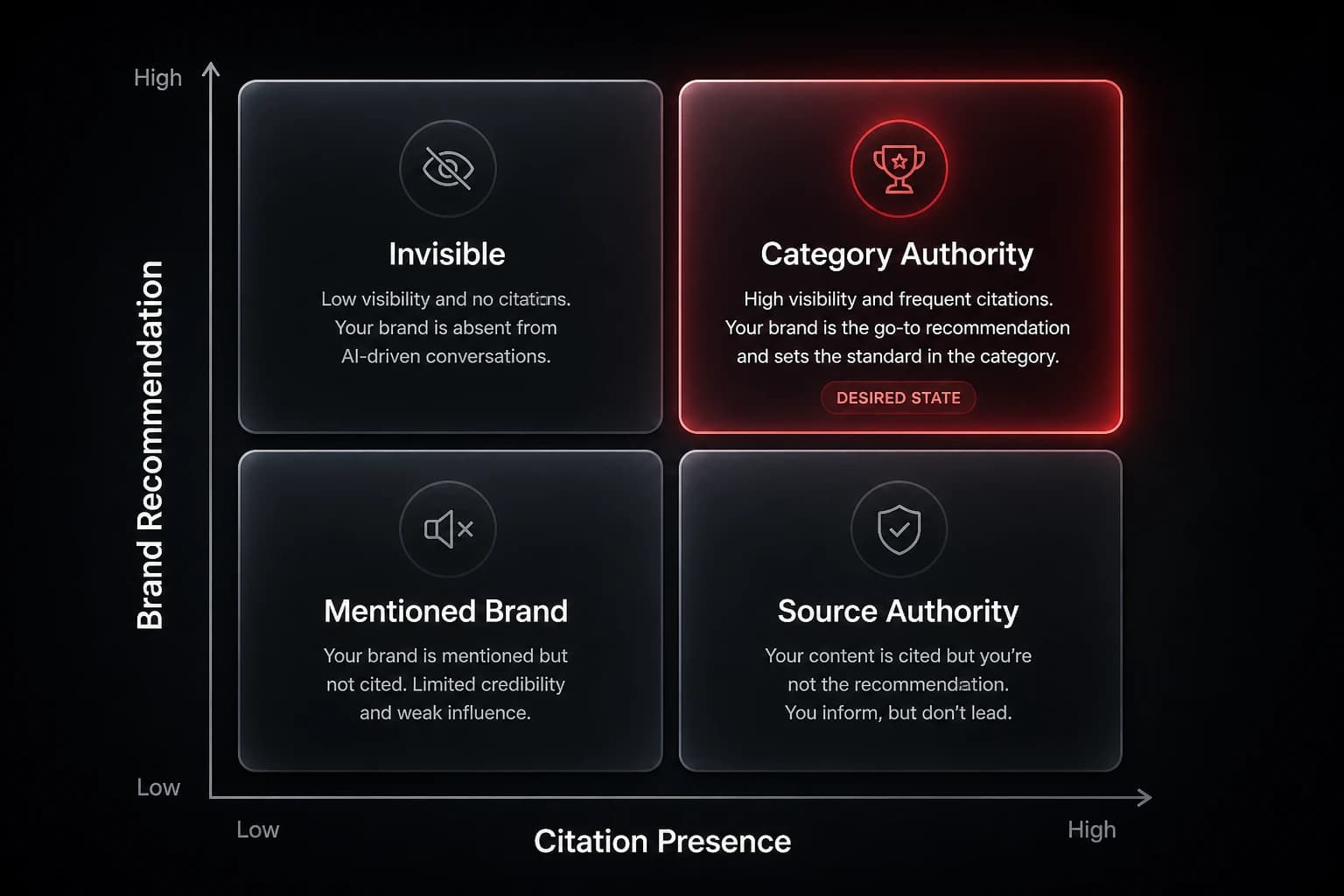
Four patterns engines use — remediation when you're named but not trusted.

Mention versus citation matrix — path to category authority
01

Definitions

AI answers use two different signals that SEO teams often collapse into one:

  • Mention — the engine names your brand.
  • Citation — the engine points to a source that supports the answer.

You can have high mentions and weak citations. You can be cited while a competitor gets the recommendation. Treat them as separate metrics with separate remediation playbooks.


AI brand mention

The model includes your brand, product name, or unmistakable entity reference in the response text.

Types MentionX extracts:

TypeExample
Explicit“Consider VendorCo for mid-market teams…”
Implicit / product“Tools like VendorCo Pro support…”
AbsentCategory discussed; your brand never appears

Metric: mention rate = mentions / engine runs on buyer prompts.

AI citation

A URL, domain, or structured source reference attached to the answer — common in Perplexity, increasingly in grounded Gemini and web-enabled ChatGPT.

Types:

TypeExample
Direct linkFootnote to yourdomain.com/pricing
Inline source listNumbered references at end of answer
Third-partyG2, Reddit, Wikipedia, analyst report

Metric: citation share = your citation credit / sum of citation credit for you + tracked competitors (not “all URLs in the scan”). See dashboard metrics explained.


02

Four patterns you will see in the wild

PatternMentionCitationWhat it means
A — Ideal✓✓ Your domainStrong entity + owned proof
B — Silent authority✗✓ Your contentYour docs/blog support category answer but brand not named — positioning gap
C — Hollow visibility✓✗ or third-party onlyNamed from model memory; no path to your proof — fragile vs updates
D — Invisible✗✗Not in consideration set

Run prompts. Classify which pattern you are in per engine — they diverge.


03

Why mentions drive revenue

Buyers act on names in the shortlist. A mention puts you in the consideration set even when zero-click.

Measure:

  • Mention rate on recommendation intents (best tools for…)
  • Mention rate on comparison intents (A vs B)
  • Share of voice vs named competitors on the same prompt set

If mention rate is 0.15 and a competitor is 0.70 on identical prompts, the pipeline problem precedes traffic analytics.


04

Why citations drive durability

Citations show what evidence the engine trusted when it formed the answer.

Repeated citation domains in your category often include:

  • Review marketplaces (G2, Capterra, TrustRadius)
  • Community threads (Reddit, Stack Overflow, niche forums)
  • Wikipedia & Wikidata (entity disambiguation)
  • Comparison & “best of” publishers
  • Official docs & API reference
  • Analyst / industry reports

Citation gap (MentionX terminology): a domain appears in ≥N competitor citations and zero yours on the same scan — a source-type you do not participate in.

Fixing citation gaps is not “more blog posts.” It is strategic presence in the source types engines already cite for your competitors.


05

Mention–citation decoupling by engine

EngineMention behaviorCitation behavior
ChatGPT (web-enabled)Strong shortlists from retrieval + trainingCitations when browsing; not always to your domain
Gemini (grounded)Google-retrieval influencedOften cites pages Google trusts
PerplexityAnswer + numbered sourcesCitations explicit — easiest to audit

Implication: A win on Perplexity citations does not automatically transfer to ChatGPT mentions. Measure separately.


06

Diagnostic workflow

Step 1 — Run a fixed prompt set
10–50 buyer intents (recommendation, comparison, alternative).

Step 2 — Tag each response
Mention? Position? Citations (domain list)?

Step 3 — Build a citation domain matrix

Domain typeCompetitor A citesYou citeAction
g2.com120Review profile + category presence
reddit.com81Community threads / AMA / use-case posts
yourdomain.com25Good — expand comparison URLs
wikipedia.org10Entity notability / disambiguation audit

Step 4 — Prioritize by prompt intent
Fix comparison prompts before vanity “brand awareness” prompts.


07

How MentionX measures this

MentionX stores every engine response and extracts:

  • Entity mentions (explicit / implicit) with position when ranked
  • Citation URLs linked to entities where schema allows
  • Citation share and citation gap vs competitors
  • Drill-down to the exact run — not a black-box score

Formulas: MentionX Methodology.


08

Remediation playbook (by pattern)

Pattern B — Cited, not mentioned

  • Strengthen entity clarity on site (Organization schema, consistent naming)
  • Publish comparison pages that name your brand in the title and H1
  • Earn third-party reviews that name you in category roundups

Pattern C — Mentioned, not cited

  • Publish cite-worthy primary sources: benchmarks, methodology, data
  • Ensure docs and pricing pages are crawlable and canonical
  • Align with sources engines already cite (reviews, directories)

Pattern D — Neither

  • Start with category recommendation prompts — understand who wins and why
  • Reverse-engineer citation domains of winners
  • Build minimum viable presence in those source types

09

FAQ

Are citations the new backlinks?
Similar in importance, different in mechanism. Citations in AI answers are evidence selections, not PageRank transfers. Measure them directly.

Should we optimize for Perplexity first?
Perplexity is the easiest citation audit. Use it as a diagnostic, not your only channel.

Do mentions require citations to convert?
Buyers may act on mentions alone (zero-click). Citations increase trust and durability when models refresh.