Insight · 9 min
Four metrics that matter: mention, position, citation, share of voice.

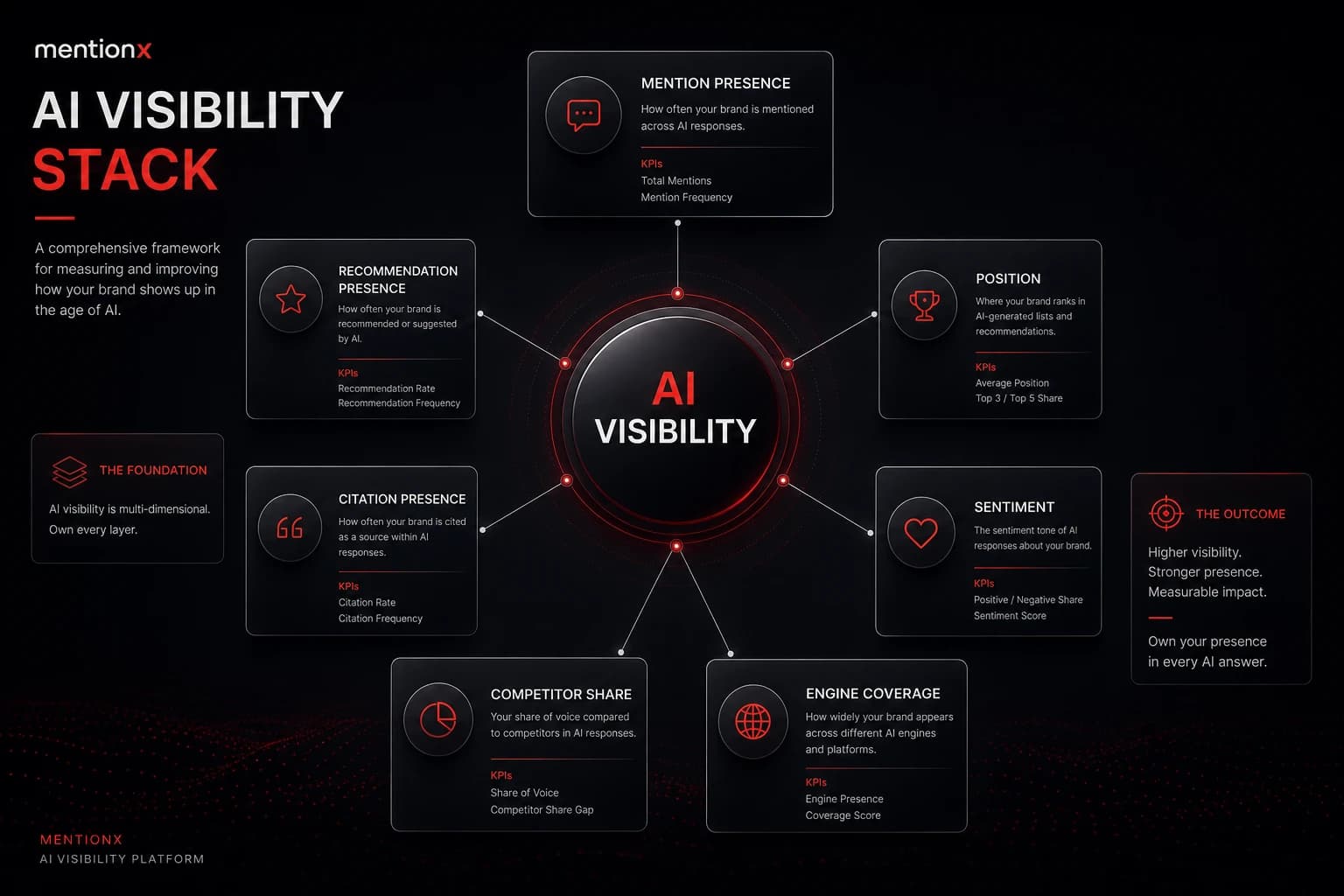
AI visibility is how often, how prominently, and how favorably AI answer engines include your brand when real buyers ask for recommendations, comparisons, and vendor advice.
It is not a vibe score. It is a set of observable signals extracted from stored engine responses:
If your brand never appears when a buyer asks “Who should I use for X?” — you have a visibility problem that traditional SEO dashboards will not show.
| Misconception | Reality |
|---|---|
| “Our ChatGPT traffic went up” | Most AI discovery happens inside the answer — zero-click. Traffic is a lagging, incomplete signal. |
| “We rank #1 on Google” | SERP position does not guarantee mention in AI summaries or chat answers. |
| “We published AI-optimized blog posts” | Content alone is not measurement. You need to run buyer prompts and inspect answers. |
| “Brand search volume” | Engines do not publish reliable query volumes for recommendation prompts. Measure outputs, not guesses. |
How often the engine names your brand across a fixed set of buyer prompts and engines.
mention_rate = mentions(your_brand) / total_engine_runs
A mention can be explicit (“Consider Acme…”), implicit (product name without company), or absent.
Why it matters: No mention = no consideration. Buyers treat the answer as the shortlist.
When the engine produces a ranked list, where do you appear?
Position 1–3 in a five-option answer is materially different from position 8 or an unranked footnote. Lower average position is better.
Why it matters: Buyers anchor on the first names they see. Position is attention economics.
Which URLs and domains does the engine cite when discussing your category?
citation_share(you) = citations_credited_to_you / sum(citations_credited_to_tracked_brands)
Neutral third-party URLs may appear in a scan but sit outside this competitive pool unless credited to you or a tracked rival. Your site may be mentioned without being cited — or cited without a mention. Both patterns imply different fixes.
Why it matters: Citations reveal which sources train the answer. If review sites and Reddit dominate competitor citations but never yours, you have a source authority gap.
Deep dive with worked examples: MentionX dashboard metrics explained.
Your mentions relative to tracked competitors on the same prompts.
SOV = mentions(you) / mentions(you + competitors)
Why it matters: Category leadership is relative. A 40% mention rate means little if a competitor hits 90% on the same questions.
These four roll up into a Visibility Score in MentionX — a weighted composite documented in MentionX Methodology.
Buyers do not only use one interface. Visibility must be tracked per engine because answers diverge:
| Surface | Buyer behavior | Measurement implication |
|---|---|---|
| ChatGPT | Asks for “best tools for…” | Recommendation + comparison prompts |
| Gemini | Research with Google grounding | Citation URLs often differ from ChatGPT |
| Perplexity | Source-forward answers | Structured citations easier to audit |
| Google AI Overviews | Zero-click summary on SERP | Overlap with but not identical to chat |
Rule: Treat each engine as a separate visibility channel until you prove parity with evidence.
SEO optimizes for crawl, index, rank, click. AI visibility optimizes for inclusion in the generated answer.
| Dimension | SEO | AI visibility |
|---|---|---|
| Unit of success | Ranking URL | Brand mention + position |
| Evidence | SERP screenshot / rank tracker | Stored full engine response |
| Competitors | Who outranks you | Who the engine names instead |
| Content lever | Keywords, backlinks, technical | Entity clarity, comparisons, third-party proof, cite-worthy sources |
| Zero-click | Growing | Default |
Deep dive: AI Visibility vs SEO.
Step 1 — Define buyer intents, not keywords
Use prompts a real buyer would ask:
MentionX generates these from your company URL via discovery — not a static keyword list.
Step 2 — Fix the prompt set and run engines
Run the same approved prompts across engines on a schedule. Store every response verbatim.
Step 3 — Extract mentions, positions, citations
Structured extraction with schema validation — not “ask GPT to score your brand.”
Step 4 — Score with versioned formulas
Reproducible metrics (mention rate, SOV, citation share) computed in application code.
Step 5 — Close the loop
Map gaps to actions: comparison pages, review presence, source types you are missing. Re-scan to prove movement.
MentionX is built around this definition:
No fabricated query volumes. Every metric traces to a stored answer. See How MentionX Works.
| Role | Primary use |
|---|---|
| CMO / Head of Growth | Category share, board reporting, budget justification |
| SEO / AEO lead | Prompt gaps, citation sources, comparison content |
| Product marketing | Positioning vs competitors in AI shortlists |
| Agencies | Client audits with auditable evidence |
→ AI Visibility for B2B SaaS · AI Visibility for Agencies
What is a good AI visibility score?
Context-dependent. Compare SOV vs direct competitors on the same prompts, and track delta over time — not an absolute benchmark from a blog post.
How often should we scan?
After material content, PR, or competitive moves — plus scheduled monitoring for Nova+ plans. AI answers drift as models and retrieval change.
Does AI visibility replace SEO?
No. It extends measurement to a discovery layer SEO tools were not built for. You still need crawlable, cite-worthy assets.
Can small brands win?
Yes — especially in niches where incumbents are weak on comparison content or third-party proof. Measurement shows where the opening is.