Guide · 12 min

Generative Engine Optimization: A Practical Guide for Marketers

Short answer

What GEO really means, why AI is changing how buyers discover brands, and how marketing teams can improve visibility using research, evidence, and a measurable strategy.

Generative Engine Optimization: A practical guide for marketers — research, evidence, and a measurable 90-day plan.
01

The GEO opportunity in one minute

What GEO really means, why AI is changing how buyers discover brands, and how marketing teams can improve their visibility using research, evidence, and a measurable strategy.

Last updated: October 2026 | Reading time: approximately 12 minutes

Your company might be performing well on Google and still be missing from an important part of the buying journey.

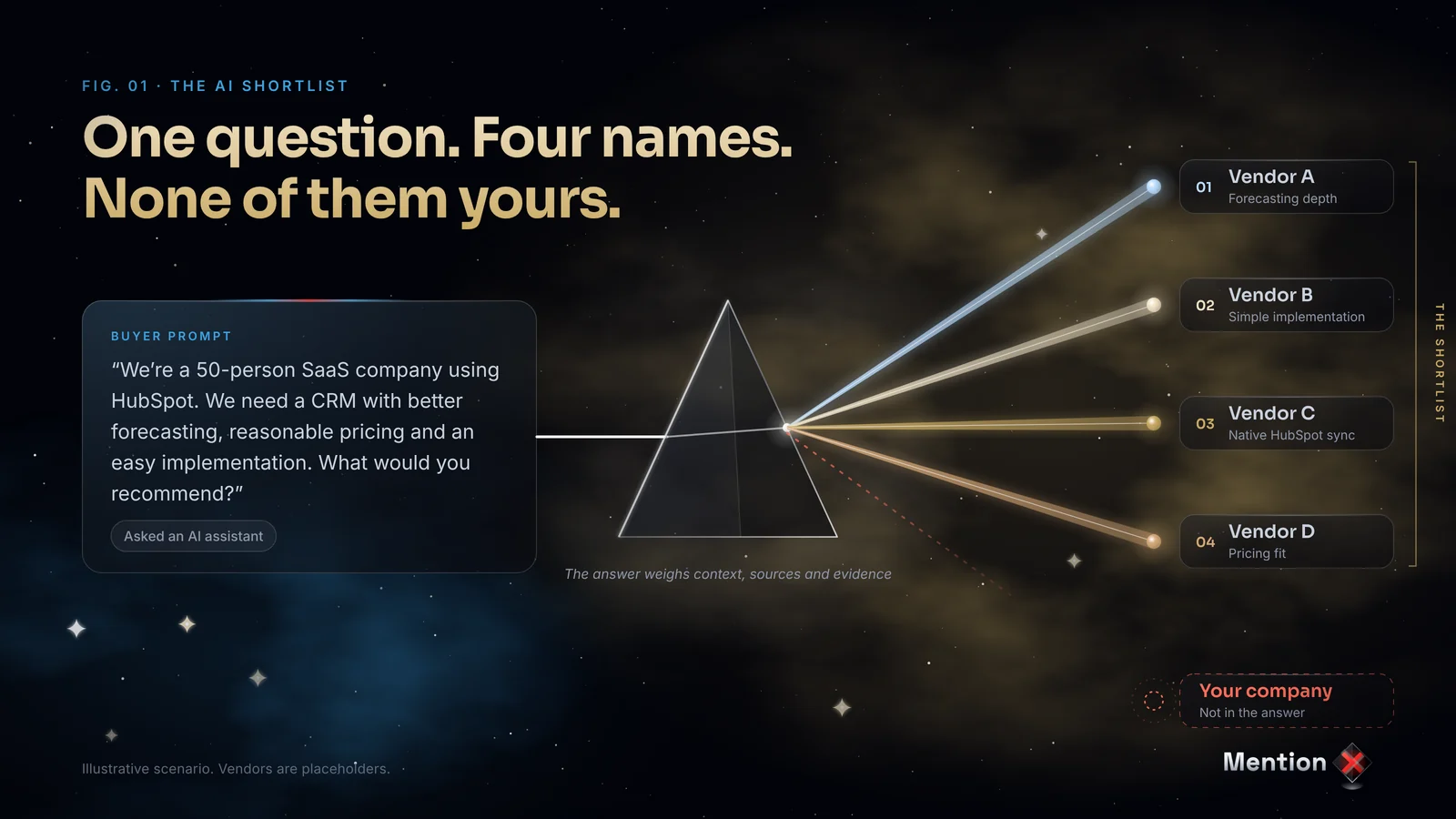
Imagine someone researching software for their business. Instead of searching Google, opening comparison websites, and visiting several vendors, they ask ChatGPT:

"We're a 50 person SaaS company using HubSpot. We need a CRM with better forecasting, reasonable pricing, and an easy implementation. What would you recommend?"

The AI responds with four products, explains their strengths, and suggests which ones deserve a closer look.

Your company isn't mentioned.

Perhaps your website ranks well for CRM related searches. Perhaps your product meets every requirement. You might even have better customer reviews than one of the recommended competitors.

But that buyer has just received a shortlist without you.

This is where Generative Engine Optimization (GEO) becomes relevant.

GEO is the practice of improving how brands, products, and information appear in responses generated by AI systems such as ChatGPT, Gemini, Claude, Perplexity, and Google AI search experiences.

For marketers, the challenge goes beyond getting mentioned. It involves understanding whether AI systems recognize your brand, accurately explain your capabilities, recommend you for relevant buyer needs, and reference credible information about your business.

The good news is that GEO doesn't require abandoning SEO or rebuilding your marketing strategy.

Much of the foundation probably already exists within your website, content, customer research, and brand reputation.

What's missing for many companies is a way to understand how that information translates into AI recommendations.

For a CMO or marketing leader, there are five things worth understanding before investing in GEO.

  1. AI is becoming part of product research. Buyers increasingly use assistants to explore categories, compare vendors, and understand purchasing options.
  2. Strong Google rankings do not guarantee AI recommendations. Different platforms can produce different answers to the same question.
  3. Good SEO remains important. Accessible websites, useful content, and credible information continue to matter.
  4. Visibility is measurable, but imperfectly. Brand mentions, recommendations, citations, and competitive presence provide useful signals when supported by actual AI responses.
  5. The best starting point is existing marketing work. Improve information gaps that matter to real buyers before investing in speculative tactics.

The rest of this guide explains how to turn those principles into a practical marketing program.

One buyer question yields an AI shortlist of competitors while your brand is absent from the answer.
02

Why GEO deserves attention now

Marketers have heard plenty of predictions about AI replacing Google.

The reality is more interesting.

AI isn't simply becoming another search engine. It is changing how some buyers conduct research.

In April 2026, software review platform G2 published its Answer Economy research, based on a survey of 1,076 B2B software buyers and decision makers.

The findings were notable:

51% of respondents said they began software research with an AI chatbot more often than with Google.

71% reported using AI chatbots at some point during software research.

These are survey findings from B2B software buyers, not percentages representing every buyer worldwide. Nevertheless, they indicate that AI has become a meaningful research channel within the category.

The change matters because software buying rarely begins with a demo request.

It begins with questions.

A marketing director might ask which attribution platforms work with HubSpot. A security leader might research alternatives to an existing compliance system. A founder might compare affordable customer support software.

Traditionally, marketers attempted to reach these buyers through organic search, paid advertising, review platforms, industry content, and community discussions.

Those channels still matter.

But AI assistants can now bring information from different sources into a single response, potentially shaping which companies buyers investigate next.

The measurement problem

Consider another finding.

In July 2025, Pew Research Center published an analysis of Google browsing behaviour involving 900 US adults.

The researchers observed that users clicked a traditional search result in 8% of visits where an AI summary appeared, compared with 15% of visits without one.

Links inside AI summaries were clicked in just 1% of visits containing those summaries.

The study establishes an association, not proof that AI summaries alone caused fewer clicks. Different search intents can produce different behaviours.

Even so, it raises an important marketing question.

What happens when buyers learn about your market without visiting your website?

Your analytics may capture a later branded search, direct visit, or demo request.

They may not reveal the AI conversation that influenced the buyer's shortlist.

That is why GEO deserves attention as a visibility and competitive intelligence discipline, not just another source of referral traffic.

03

GEO, SEO, and AEO: how they fit together

The terminology can get confusing.

SEO, AEO, and GEO are often presented as separate disciplines, each requiring its own strategy.

In reality, there is considerable overlap.

DisciplineMain objectiveTypical measurement
SEOHelp relevant pages appear in search resultsRankings, impressions, clicks, conversions
AEOHelp answer systems understand and present useful informationAnswer inclusion, accuracy, source visibility
GEOImprove brand and content visibility in generative AI responsesMentions, recommendations, citations, competitive presence

AEO stands for Answer Engine Optimization. Its definition overlaps with GEO, and there is no universally accepted technical boundary between the two.

The more important point is that GEO extends SEO rather than replacing it.

Google's official guidance for AI search features confirms that established SEO practices remain relevant to AI Overviews and AI Mode.

That includes making content accessible, helping search systems discover important pages, and publishing useful information.

For most companies, the sensible approach is to integrate GEO into existing SEO, content, product marketing, and brand activities.

You don't need three teams doing overlapping work.

You need a clearer understanding of how buyers discover and evaluate your company.

For a deeper explanation, see AI Visibility vs SEO: What Changes for Marketers.

04

How AI decides which brands to mention or recommend

There is no universal AI ranking algorithm marketers can reverse engineer.

Different platforms use different models, retrieval systems, information sources, and response generation methods.

Some responses are influenced by information learned during training. Others use current search results or retrieved documents.

A platform may combine several sources before producing a recommendation.

The precise internal decision process is not fully public.

Still, marketers can understand the main information problems involved.

Relevance comes first

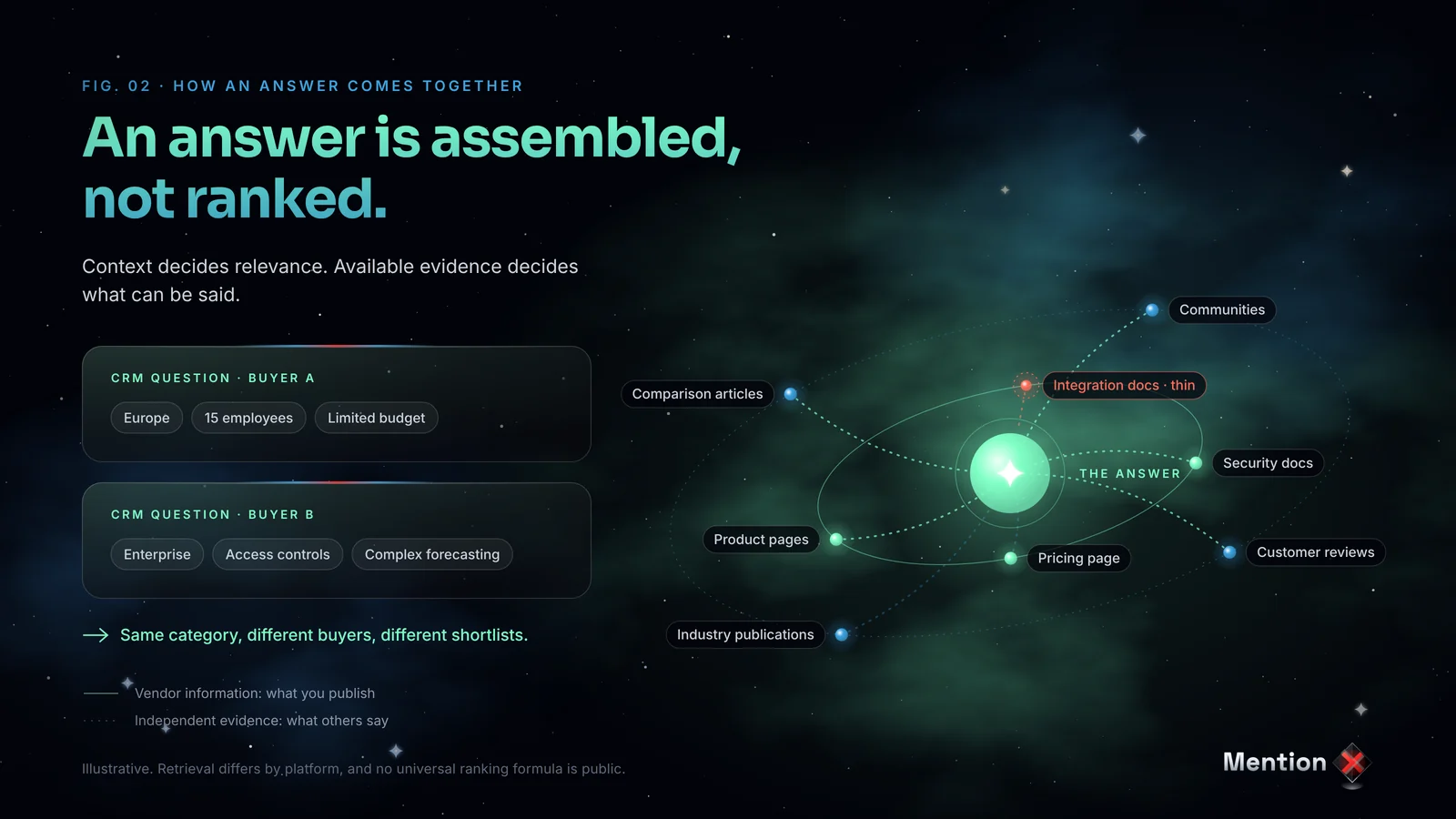
Imagine someone asks:

"Which CRM is suitable for a European startup with 15 employees and a limited budget?"

Now compare that with:

"Which CRM is best for a global enterprise requiring advanced access controls, complex forecasting, and extensive customization?"

Both questions concern CRM software.

But they describe different buyers.

An AI response that considers the buyer's needs might suggest different products for each.

This means appearing in every category question should not be the objective.

The goal is to appear where your product is genuinely relevant.

Available information matters

AI systems may draw upon product documentation, company websites, reviews, independent publications, and other accessible material.

Suppose a software company genuinely supports Salesforce integration, but the integration is barely explained on its website.

Meanwhile, a competitor has detailed documentation covering setup, supported data fields, limitations, and common use cases.

The competitor has provided more explicit information that could help answer a buyer's integration question.

That doesn't guarantee an AI recommendation.

It does reveal a content gap worth addressing.

Independent evidence can add useful context

Buyers rarely make software decisions based exclusively on vendor claims.

They consult customers, independent reviews, comparisons, analysts, and professional communities.

AI systems can also reference information from such sources when available.

A product's presence in these environments may therefore contribute to the information available during AI research.

However, no credible universal formula tells us how many reviews, mentions, or backlinks produce a recommendation.

The practical approach is to improve relevant evidence and observe whether the answers change.

An answer is assembled from buyer context, vendor pages, and independent evidence—not ranked like search results.
05

Start by understanding what your buyers actually ask

This is where I'd recommend beginning a GEO project.

Not with another blog article. Not with a technical audit containing hundreds of generic recommendations.

Start with your customers.

Most B2B companies already possess valuable research hidden inside sales calls, customer interviews, support conversations, win and loss analysis, and CRM notes.

Those conversations reveal how people describe their problems before they know which product to buy.

A simple example

Imagine you're marketing a customer support platform.

Traditional keyword research might identify:

"Customer support software"

"Help desk tools"

"Zendesk alternatives"

Those are useful terms.

But real buyers often have more specific needs.

Buyer intentExample question
DiscoveryWhat customer support platforms work well for growing SaaS companies?
Problem solvingHow can we reduce repetitive support tickets without expanding our team?
ComparisonIs Freshdesk or Zendesk better for a 30 person support team?
AlternativesWhat are affordable Zendesk alternatives with strong automation?
RequirementsWhich platforms support HubSpot, multilingual support, and EU data requirements?

The difference is context.

Company size, existing tools, budget, geography, and implementation constraints can all influence recommendations.

These are the questions marketers should investigate.

How many prompts should you monitor?

For an initial project, I recommend 30 to 50 carefully selected questions covering your priority products, use cases, and buyer requirements.

This is a practical starting range, not an industry standard or a statistically representative sample.

Include both branded and unbranded questions.

Branded questions reveal how your company is described and compared. Unbranded questions help show whether you appear before the buyer already knows your name.

When possible, separate markets and languages rather than treating all buyers as one audience.

Most importantly, don't mistake artificially generated questions for proven customer demand.

Use genuine customer evidence to choose the subjects.

06

How to measure your visibility in AI

One of the industry's biggest problems is its tendency to reduce AI visibility to a single percentage.

A score can be useful, but it does not tell the whole story.

Consider an AI response containing these statements:

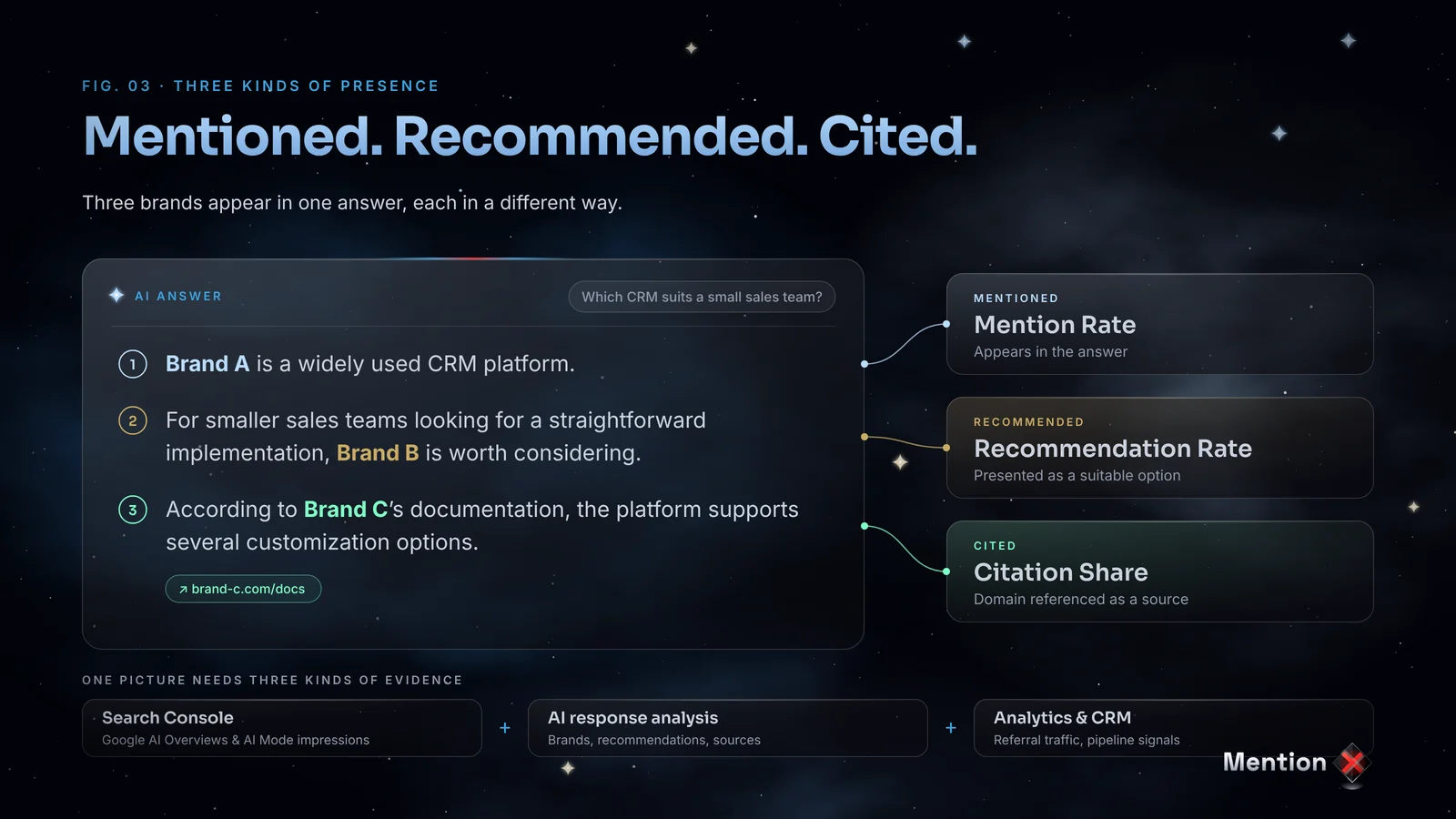
"HubSpot is a widely used CRM platform."

"For smaller sales teams looking for a straightforward implementation, Pipedrive is worth considering."

"According to Salesforce's documentation, the platform supports several customization options."

Three companies appear, but in different ways.

One is mentioned. Another is recommended. The third is cited as a source.

These distinctions matter.

The metrics marketers should understand

MetricWhat it tells you
Mention RateHow often your brand appears within the measured responses
Recommendation RateHow often your brand is presented as a suitable option
Share of VoiceYour relative presence compared with selected competitors
Citation ShareHow frequently your domain is referenced within the defined citation measurement
Brand accuracy and sentimentWhether your company is described correctly and in what context
Referral and pipeline signalsWhether AI assisted discovery appears connected to business outcomes

Measurement definitions can vary between platforms. Before comparing scores, examine how each tool calculates them.

A company might have strong Mention Rate but relatively weak Recommendation Rate.

That could mean buyers are being introduced to the brand without receiving a positive suitability recommendation.

Or the prompts may include questions where the company should not reasonably be recommended.

Context determines whether the gap is meaningful.

See Brand Mentions vs Citations for a closer explanation of why these signals should not be confused.

What about Google Search Console?

There has been an important development here.

In June 2026, Google announced dedicated Generative AI performance reports in Search Console. Google states that the reporting was rolled out worldwide by August 31, 2026.

These reports provide information about impressions in Google's generative AI experiences, including AI Overviews and AI Mode, along with page, country, device, and time dimensions where supported.

This is useful first party visibility information.

However, impressions do not tell you every brand recommended in a response, why a competitor appeared, or how your company performs across non Google AI platforms.

A complete measurement approach combines three types of evidence:

Search Console for Google search visibility.

AI response analysis for brand presence, recommendations, sources, and competitors.

Analytics and CRM for referral traffic, customer acquisition, and commercial signals.

None gives the complete answer alone.

Mentioned, recommended, and cited are three different kinds of AI visibility, each measured with different evidence.
07

A practical example: turning GEO findings into marketing actions

Let's make this tangible.

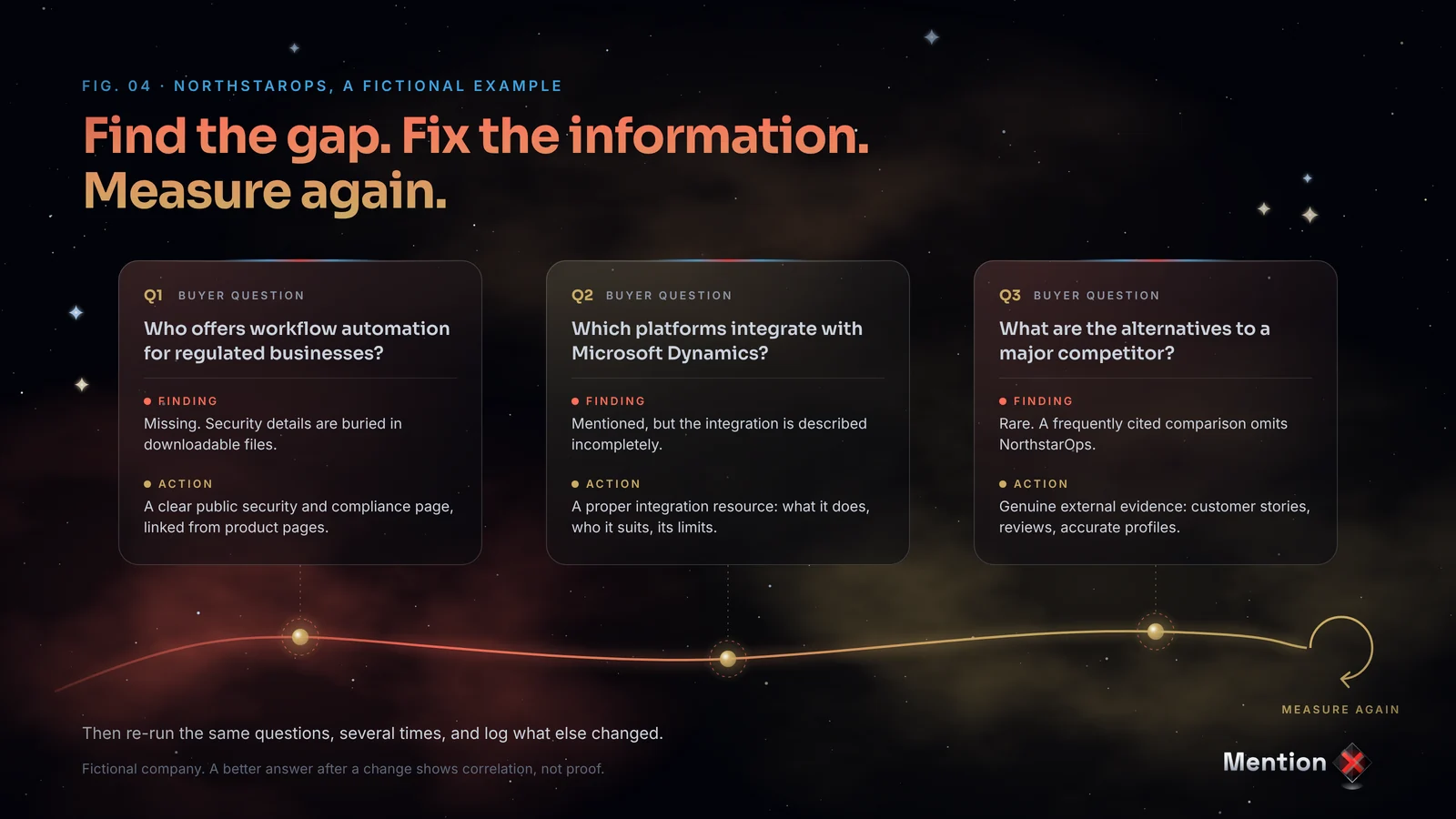
Imagine a fictional B2B software company called NorthstarOps.

It sells workflow automation software to midmarket businesses and competes with several established providers.

Its marketing team notices that competitors repeatedly appear when AI assistants are asked about workflow automation for financial services companies.

Instead of immediately creating new content, the team investigates three buyer questions.

Question one: Who offers workflow automation for regulated businesses?

NorthstarOps is missing from several sampled responses.

Competitors appear with references to compliance and security documentation.

The marketing team discovers that NorthstarOps has relevant security documentation, but important details are buried within downloadable files and difficult to find.

Recommended action: Improve the public security and compliance information, link to it from relevant product pages, and make the supported claims clear.

The objective is not to create more marketing language. It is to make verifiable information easier to discover.

Question two: Which platforms integrate with Microsoft Dynamics?

NorthstarOps is occasionally mentioned, but its integration capabilities are described incompletely.

The integration exists.

However, the website provides little information about setup, supported functionality, or limitations.

Recommended action: Work with product marketing and engineering to publish a proper integration resource.

Include what the integration does, who it is suitable for, and where limitations apply.

Question three: What are the alternatives to a major competitor?

NorthstarOps appears rarely.

An independent comparison article repeatedly shows up among the cited sources, but it does not include NorthstarOps.

The team investigates whether the article covers the same market segment and whether the product meets its evaluation criteria.

Recommended action: Where relevant, build genuine external awareness through customer stories, independent reviews, accurate directory profiles, and appropriate industry outreach.

Buying mentions or manipulating online discussions would not be a credible solution.

How to evaluate the changes

After documenting and implementing these improvements, the team repeats its original questions.

It compares the actual responses, brand presence, factual accuracy, competitor recommendations, and cited sources.

Ideally, prompts should be repeated across multiple runs because AI answers can vary.

A positive result might be that the integration is now described correctly or that NorthstarOps appears more consistently in relevant comparisons.

But an improvement following a website update does not automatically prove that the update caused it.

Models change. Sources change. Competitors also change their content.

The team should document those possibilities rather than turning correlation into a success claim.

That is what a responsible GEO project looks like: identify a meaningful information gap, address it, and measure what happens.

Find the gap, fix the information, and measure again—illustrated with fictional company NorthstarOps.
08

Which GEO activities are actually worth investing in?

Once you have evidence, the next challenge is deciding where to spend time and money.

Not every missing mention deserves a content project.

For a CMO, the important question is whether a visibility gap is commercially meaningful and realistically addressable.

I would assess each opportunity against four criteria:

Commercial relevance: Does the question relate to an important product, market, or buyer segment?

Evidence strength: Is the problem repeated across several responses, or did it appear once?

Ability to influence: Can your company improve the underlying information, or is the result largely outside your control?

Execution effort: Can an existing team make a useful change without delaying higher priority work?

Here are the activities I would normally evaluate first.

Improve existing product and comparison pages

Many SaaS websites have strong design but weak practical detail.

They describe benefits without explaining supported requirements, implementation considerations, product limitations, or differences between alternatives.

Improving these pages can benefit SEO, sales enablement, and buyer understanding at the same time.

Build original evidence

Customer case studies, implementation findings, benchmarks, and transparent research can help explain why a product is suitable for a particular problem.

A credible customer story with a clear business situation, implementation, and measurable outcome is more useful than another unsupported claim about being an industry leader.

Do not invent statistics to make an article look authoritative.

The original GEO academic research reported visibility improvements of up to 40% under certain experimental conditions, with results varying across domains.

That finding supports studying content characteristics. It does not guarantee similar gains from adding statistics or citations to commercial websites.

Strengthen genuine external credibility

Look at the publications, review platforms, partner websites, and specialist communities that matter to your audience.

Are your company details accurate?

Are your product capabilities properly represented?

Do authentic customer reviews explain specific use cases?

Does your business contribute useful expertise where potential buyers research problems?

Focus on relevance and credibility rather than the raw number of placements.

Fix technical problems that actually limit accessibility

Check whether important information is publicly accessible, indexable where appropriate, and easy to navigate.

Google states that special structured data or machine readable AI files are not required for inclusion in its AI search features.

Likewise, adding llms.txt is not a proven shortcut to better recommendations.

For ChatGPT Search, OpenAI separately documents OAI SearchBot, which website owners can manage independently of GPTBot, its crawler associated with potential model training.

Crawler access decisions should reflect your legal, security, and content policies.

For a fuller technical and content review, use the MentionX AI Search Optimization Checklist.

09

Your first 90 days of GEO

You do not need a new department.

For most marketing organizations, I would begin with a focused project involving SEO, content marketing, product marketing, and analytics.

The objective is to establish whether the opportunity is meaningful before expanding investment.

Days 1 to 30: establish your baseline

Select your priority category, markets, and main competitors.

Build a prompt library from real buyer research.

Run the questions across relevant AI platforms and preserve the responses.

Review which brands appear, how they are described, which sources are cited, and where important inaccuracies exist.

Deliverable: A baseline report identifying the three to five most commercially relevant visibility gaps.

Days 31 to 60: improve the information

Prioritize a small number of changes.

These might include improving a product comparison, fixing incomplete integration information, updating an existing article, publishing an authentic case study, or correcting inaccurate third party profiles.

Assign clear ownership.

Record what changed and when.

Deliverable: Completed improvements linked to specific buyer questions and documented evidence.

Days 61 to 90: measure and decide

Repeat the original benchmark under comparable conditions.

Examine changes in visibility, recommendations, source coverage, and information accuracy.

Review AI referral traffic, relevant search data, and any customer research indicating AI assisted discovery.

Do not invent causality when the data cannot establish it.

Then decide whether GEO deserves more investment, should remain part of existing SEO operations, or needs further testing.

Deliverable: A leadership review showing what was learned, what changed, and the next investment decision.

Who should own what?

TeamMain responsibility
SEOTechnical accessibility, content discovery, search reporting
Product marketingPositioning, use cases, comparisons, product accuracy
ContentImprove relevant educational and commercial resources
PR and customer marketingIndependent coverage, credible customer evidence
Analytics and RevOpsVisibility reporting, referral traffic, attribution
CMO or marketing directorPrioritization, resource allocation, business impact

The project succeeds when these teams act on shared evidence rather than treating GEO as an isolated content production exercise.

Ninety days in three phases—baseline, improve information, measure and decide—on a practical GEO timeline.
10

How to know whether GEO is producing meaningful results

A higher AI visibility score can be encouraging.

But it should not automatically be presented as business growth.

I would evaluate GEO across three levels.

First: Did the information improve?

Can AI systems now describe your company more accurately?

Are relevant capabilities easier to identify?

Have repeated inaccuracies become less common?

These are meaningful improvements even before a measurable commercial effect appears.

Second: Did competitive visibility change?

Are you mentioned or recommended more consistently for suitable buyer questions?

Has your relative presence changed against relevant competitors?

Are new sources referencing your company?

Be careful with small samples. Results can be affected by prompt selection, platform updates, localization, and model variability.

Third: Is there evidence of commercial value?

Look for changes in AI referral traffic, qualified enquiries, customer interviews, and self reported discovery sources.

Include AI as an option in your "How did you hear about us?" research where appropriate.

But avoid assigning a revenue number to GEO simply because a prospect used ChatGPT during research.

Attribution may be incomplete or shared across several channels.

A useful leadership report should make these distinctions clear.

For example:

"Our brand is now described more accurately in the integration questions we tested. Recommendation frequency has improved across the sampled prompts, although we cannot yet attribute additional pipeline to those changes. We recommend continuing measurement while prioritizing two further content gaps."

That is a credible business update.

It gives leadership a decision without overstating the evidence.

11

Five GEO mistakes marketers should avoid

Treating one ChatGPT answer as your overall visibility

One response is an observation, not a market benchmark.

Use relevant prompts, multiple responses where feasible, and comparable measurement periods.

Producing content solely for AI systems

Publishing hundreds of generic comparison pages or artificial FAQs may create more URLs without helping buyers.

Useful content should solve real information problems.

Confusing citations with endorsements

A company can be cited as a source without being recommended.

A competitor can be recommended without its own website being cited.

Those are different signals.

Assuming every competitor mention is a problem

A competitor may genuinely be more suitable for a particular buyer.

Before trying to change the answer, establish whether your product actually meets the requirements.

Promising guaranteed AI rankings

No marketer controls every AI platform's generated answers.

Avoid agencies or tools promising permanent top recommendations or precise results from universal GEO tricks.

12

What GEO means for the future of marketing

GEO is often discussed as the next SEO.

I think that description is too narrow.

The larger change is that buyers can increasingly ask AI assistants to help them understand a market before deciding which companies to investigate.

That changes where brand perception can begin.

It also creates new questions for marketing teams.

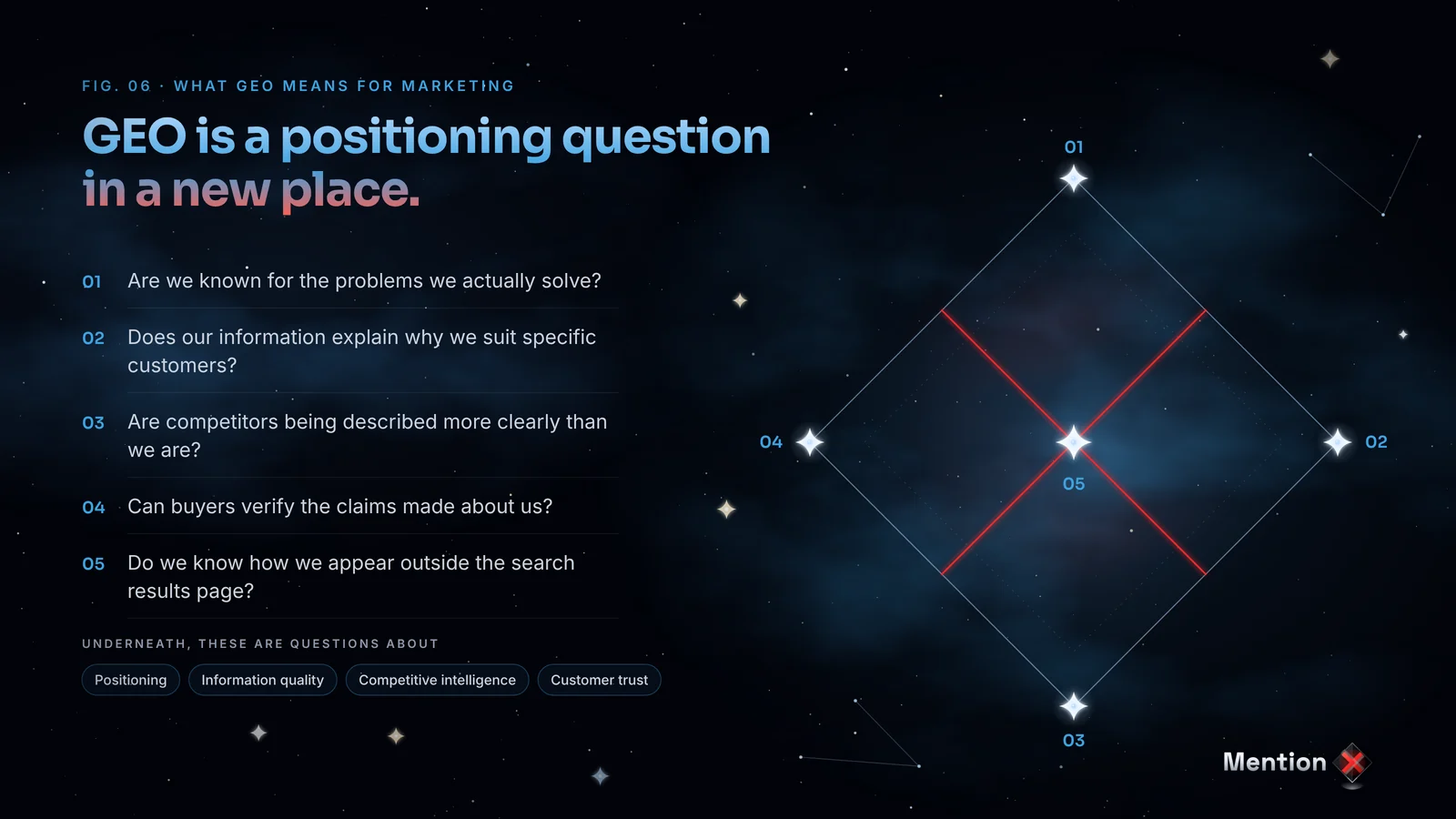
Are we known for the problems we actually solve?

Does our information explain why we are suitable for specific customers?

Are our competitors being described more clearly?

Can potential buyers verify the claims made about us?

And do we understand how our brand appears outside the traditional search results page?

These are fundamentally questions about positioning, information quality, competitive intelligence, and customer trust.

GEO brings them into a new environment.

That is why I would avoid treating it as another campaign channel with a fixed set of optimization tricks.

The most useful approach is to make GEO part of your existing marketing decision process.

Understand your buyers. Publish accurate and genuinely useful information. Earn appropriate external credibility. Measure what AI systems say. Investigate the gaps.

Then make better marketing decisions.

GEO is a positioning question in a new place—five strategic questions for marketing leaders.
13

Frequently asked questions about GEO

What is Generative Engine Optimization?

Generative Engine Optimization, or GEO, is the practice of improving how brands and content appear in AI generated responses. It includes work on discoverability, information accuracy, relevant content, brand reputation, and measurement.

Does GEO replace SEO?

No. Traditional SEO remains important, particularly for website accessibility, indexing, and discoverability. GEO adds the measurement of brand presence and recommendations within AI generated answers.

Make sure your product information is clear, accurate, and accessible where appropriate. Explain relevant use cases, provide credible evidence, and maintain accurate information across important external sources. Then assess real buyer questions. Recommendations cannot be guaranteed.

Read How ChatGPT Recommends Brands for more detail.

How long does GEO take to show results?

There is no reliable universal timeframe. Different platforms update and retrieve information differently. A 90 day project is useful for establishing a baseline, implementing improvements, and evaluating initial changes, not guaranteeing higher recommendations.

Is GEO worth investing in for a small business?

It can be, particularly when potential customers use AI to evaluate providers in the business's category. Start with a limited audit and use the findings to decide whether further investment makes sense.

How much should a company spend on GEO?

There is no universal budget benchmark. Begin by using existing SEO, content, product marketing, and analytics resources. Expand investment when evidence indicates a commercially relevant opportunity.

Can AI visibility generate leads?

AI platforms can refer visitors to websites, and AI research may influence subsequent buying decisions. However, the relationship between visibility and revenue is difficult to isolate. Track referrals and customer discovery sources while avoiding unsupported attribution claims.

14

Final thought: GEO should make marketing smarter

If your company is already investing in SEO, content marketing, digital PR, customer research, and competitive positioning, you have much of the foundation needed to begin GEO.

The first priority isn't publishing more content.

It's understanding whether the information already available about your company helps potential buyers make informed decisions.

Start with the questions customers actually ask.

Examine how AI systems respond.

Find the gaps that matter.

Improve what your team can genuinely influence.

Measure again.

A successful GEO strategy isn't one that makes AI mention your brand everywhere. It's one that improves your chances of being accurately considered when your product is relevant, while giving your marketing team evidence to make better decisions.

Further reading from MentionX

If you want to explore individual areas in more depth, these resources provide additional context:

About MentionX

MentionX helps marketing teams understand how their brands appear across AI discovery platforms.

It measures brand visibility, recommendations, competitive presence, and cited sources using recorded AI responses. Teams can investigate what AI systems say, where competitors appear, and which opportunities deserve attention.

MentionX supports ten AI platforms and search experiences. Its published methodology explains how the measurements are calculated and the limitations marketers should consider.

The purpose is straightforward: to make AI discovery more understandable, measurable, and actionable for marketing teams.