Insight · 14 min
Your website can perform well in Google Search while your brand remains almost invisible in AI recommendations. Here's why the difference matters, what your current reporting may be missing, and how to bring both together.

Updated: October 2026
Imagine two conversations happening in the same marketing meeting.
Your SEO manager reports that organic visibility is improving. Important keywords are ranking well, traffic is growing, and several landing pages are generating qualified leads.
Then your sales director mentions something unexpected.
Three recent prospects arrived with vendor shortlists they had researched using ChatGPT. Your company wasn't included in any of them.
Both observations can be true.
The SEO team may be doing excellent work. Your website could genuinely outperform competitors in organic search. But buyers now have another way to discover and compare companies, and your existing search reports may not tell you how your brand appears there.
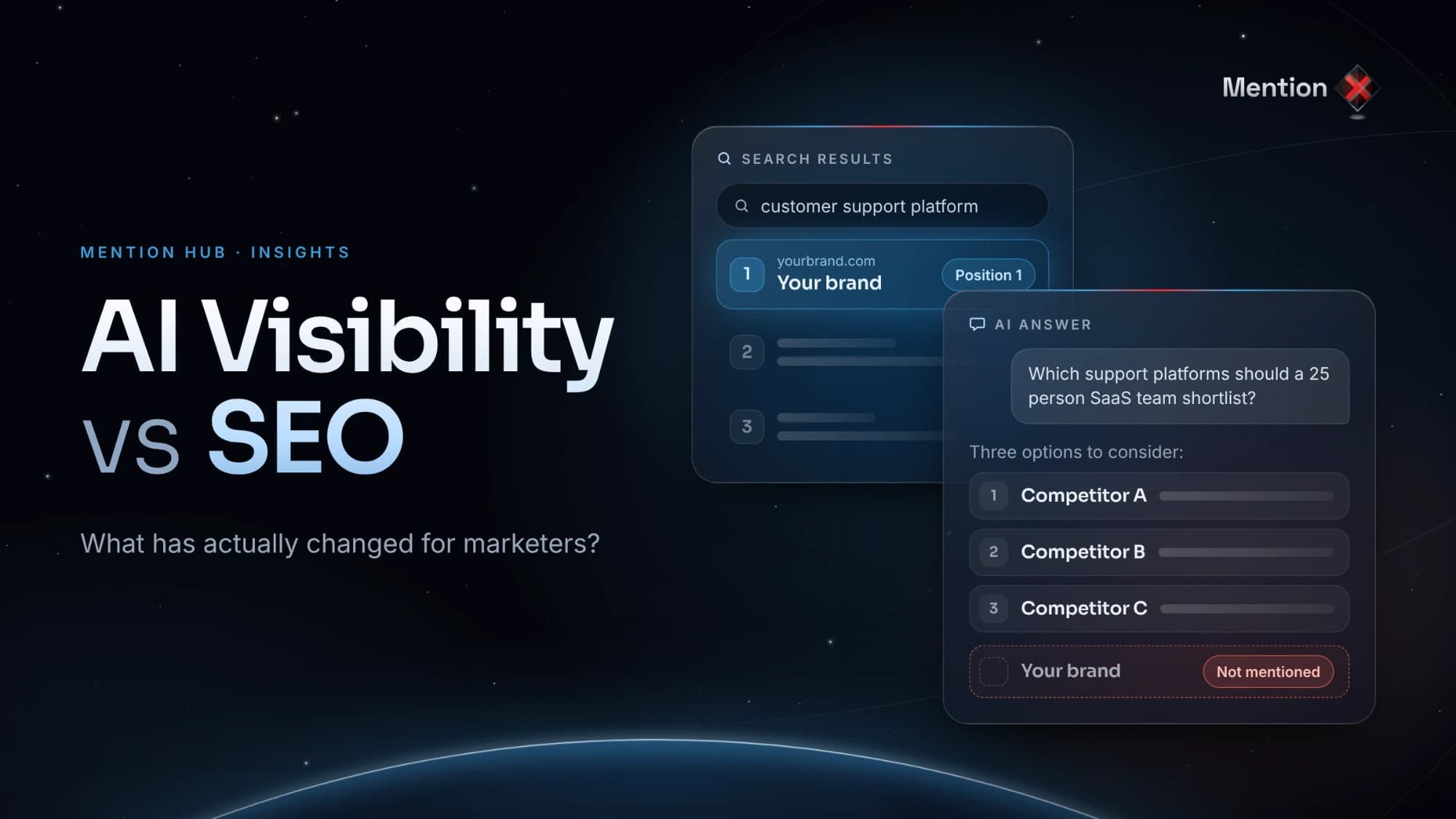
This is the distinction between SEO visibility and AI visibility.
SEO helps marketers understand how websites perform in search engines. AI visibility adds another perspective: how brands, products, and competitors appear in answers generated by AI systems.
For marketing leaders, this isn't about choosing one over the other.
It's about understanding a part of the buying journey that has become increasingly difficult to observe through traditional reporting.
AI is becoming part of how people research products, especially in B2B software.
In July 2026, G2 published its Buyer Behavior Report, drawing on a survey of more than 1,000 B2B software buyers and decision makers.
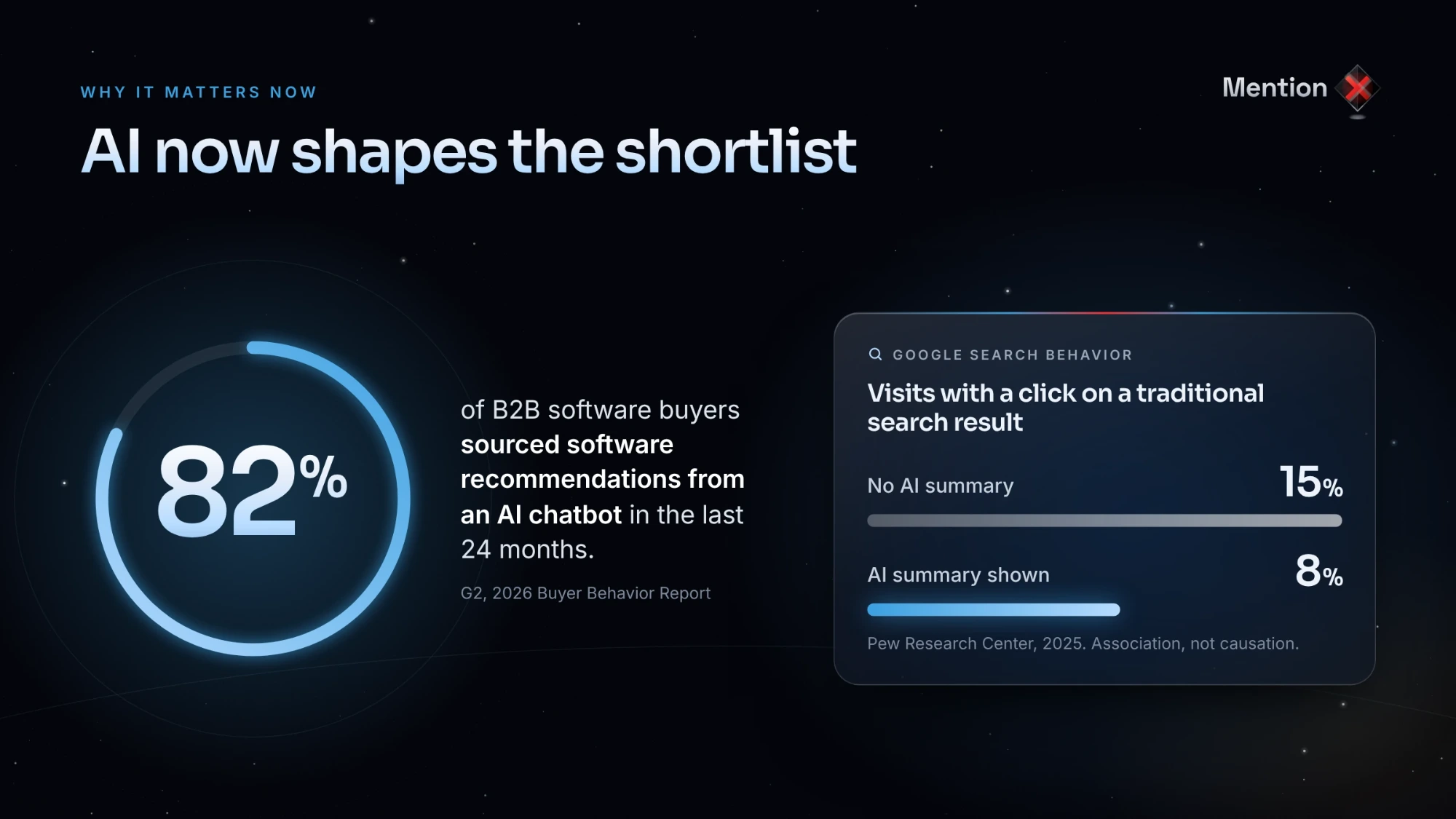
The research found that 82% of respondents had sourced software recommendations from an AI chatbot during the previous 24 months.
Among those buyers, half said AI had its greatest influence when narrowing and comparing options.
That doesn't mean AI has replaced Google, software review platforms, or traditional vendor research.
It means another source of information is influencing which companies buyers consider.
There's also evidence that the way people interact with search results is changing.
A 2025 Pew Research Center study found that Google users clicked a traditional search result in 8% of visits where an AI summary appeared, compared with 15% of visits without one.
The research shows an association rather than proving that AI summaries caused the difference.
Still, it highlights a practical problem for marketers.
A potential customer can receive useful information about your industry, evaluate several companies, and develop an initial preference without visiting any of their websites.
When that happens, website traffic alone doesn't capture the entire discovery process.

Traditional SEO reporting is designed to explain how people discover and interact with your website through search engines.
You can see which queries generate impressions, which pages receive clicks, how rankings change, and which visits contribute to conversions.
AI visibility examines a different set of questions.
When someone asks ChatGPT, Gemini, Claude, Perplexity, or another AI assistant about your product category, does your company appear?
Is the information accurate?
Are you presented as a relevant option?
Which competitors are discussed, and what sources support the response?
Here is how the two approaches compare.
| Area | SEO | AI visibility |
|---|---|---|
| Primary focus | Search performance of websites and pages | How brands and information appear in AI responses |
| Common metrics | Rankings, impressions, clicks, CTR, conversions | Mentions, recommendations, citations, Share of Voice, accuracy |
| Competitive analysis | Which websites and pages compete in search | Which brands appear together in AI answers |
| Main evidence | Search Console, search results, analytics | Recorded AI responses, prompt analysis, sources |
| Business question | Are buyers finding our website? | Are buyers being introduced to and informed about our brand? |
These are complementary perspectives, not completely separate disciplines.
SEO has always involved brand visibility, authority, search features, and competitive positioning. AI visibility builds upon those ideas, adding measurements that page rankings alone cannot provide.
For a broader explanation of the underlying discipline, see our practical guide to Generative Engine Optimization.
Let's use a software example.
Your company sells a customer support platform. Its comparison page ranks near the top of Google for a valuable keyword such as "Zendesk alternatives".
That is a meaningful SEO achievement.
Now imagine a buyer asks an AI assistant:
"We're a European SaaS company with a 25 person support team. We need an alternative to Zendesk with strong automation, HubSpot integration, and multilingual support. What should we consider?"
The AI might suggest several competitors without mentioning your product.
Why?
There isn't one universal explanation.
The assistant might have found more detailed information about competitors. It might be drawing on independent sources that discuss those products. Or it might have interpreted the buyer's requirements in a way that makes other platforms appear more suitable.
It's also possible your product genuinely lacks something important.
That last possibility matters. Not every missing recommendation represents an optimization opportunity.
Before producing new content, marketers should examine the actual response and determine whether there is an information gap, a positioning problem, or a genuine product difference.
A strong Google ranking establishes that a page can perform well in search. It doesn't establish how every AI system will interpret your company's relevance to a particular buyer.
Quite a lot.
There is no reason for a company with a strong SEO strategy to abandon it because AI discovery is growing.
Google's official guidance on AI features in Search continues to emphasize established SEO fundamentals.
Important pages should be accessible, useful, appropriately indexed, and supported by a clear website structure.
The same applies to content quality.
A detailed product page that explains integrations, pricing, implementation requirements, and limitations is useful to prospective customers regardless of how they discover it.
Credible customer evidence, relevant industry coverage, and accurate company information also remain valuable.
What needs to change is the assumption that improvements in SEO metrics automatically tell the entire story of brand discovery.
A company may need to evaluate both its search performance and the way AI assistants describe its products.
These are different observations about a connected buying journey.
Suppose your marketing team is tracking 40 buyer questions across several AI platforms.
You discover that your brand appears regularly in broad category discussions but rarely in comparisons involving enterprise requirements.
That is worth investigating.
Perhaps the product is positioned too heavily toward smaller businesses. Perhaps its enterprise capabilities are poorly documented. Or perhaps competitors have stronger evidence for those specific requirements.
Now consider a different finding.
An AI assistant mentions your company frequently but repeatedly describes it as expensive, difficult to implement, or unsuitable for certain customers.
Even if some of those descriptions are inaccurate, they may influence how a buyer perceives your business.
Traditional rank tracking won't directly explain these narratives.
AI visibility analysis can help uncover them.
But marketers should avoid reducing everything to one visibility score.
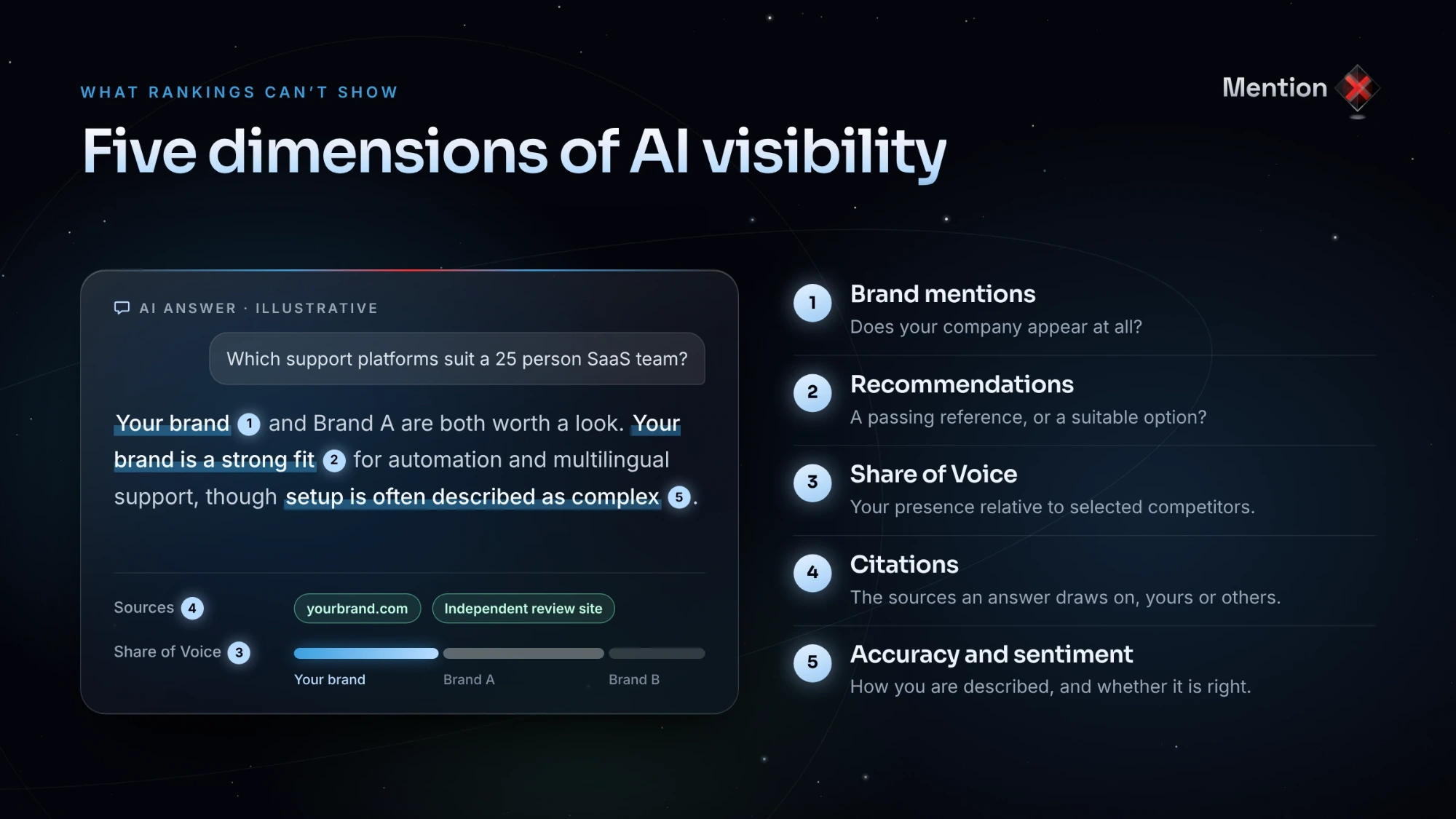
A useful assessment looks at several dimensions.
Brand mentions show whether your company appears within the questions being monitored.
Recommendations help distinguish a passing reference from an answer that presents your product as a suitable option.
Competitive Share of Voice shows relative presence against a selected group of competitors within a defined measurement sample.
Citations reveal which sources are referenced in responses, including whether your website or relevant independent publications appear.
Brand accuracy and sentiment help identify recurring descriptions, factual mistakes, or potentially misleading positioning.
None of these metrics should be interpreted without the original response.
For example, being cited as a source is not the same as being recommended as a vendor.
We explain that distinction in Brand Mentions vs Citations in AI Search.

The good news is that you don't need to replace your existing reporting stack.
You need to connect the information it already provides with relevant AI visibility observations.
Search Console remains essential for understanding Google Search performance.
In June 2026, Google announced dedicated Generative AI performance reporting, which became available worldwide by August 31.
These reports help website owners understand impressions within Google's generative AI experiences, including AI Overviews and AI Mode, with breakdowns such as pages, countries, devices, and dates where available.
This makes Search Console more useful for analyzing Google's AI discovery features.
However, it does not provide a complete picture of which competitors are recommended across ChatGPT, Claude, Gemini, or other independent platforms.
Nor does a page impression explain whether your company was recommended as a suitable product.
Monitor questions that reflect genuine customer needs.
Review whether your brand appears, how it is described, which companies appear alongside it, and which sources are cited.
Tools such as Ahrefs Brand Radar and Semrush's AI Visibility Toolkit now offer AI visibility capabilities alongside their established SEO products.
Specialist platforms, including MentionX, also provide dedicated AI response monitoring and competitive analysis.
The important distinction is between the metrics being measured, not whether a tool is traditionally classified as SEO software.
Use analytics and CRM data to investigate whether AI assisted discovery appears to contribute to website visits, qualified enquiries, or pipeline.
Some AI referral traffic can be identified directly.
Other influence may be harder to capture.
A buyer could discover your company through an AI answer, visit an independent review platform, search your brand later, and eventually request a demo.
No single attribution report necessarily captures every stage.
Treat AI visibility as additional evidence rather than automatically assigning it revenue credit.
The real value comes from interpreting both datasets together.
| What you observe | What to investigate |
|---|---|
| Strong SEO, weak AI visibility | Buyer prompt relevance, brand information, product positioning, competitive evidence |
| Weak SEO, strong AI visibility | Search discoverability, landing pages, conversion opportunities |
| Strong visibility in both, few leads | Buyer intent, conversion experience, lead quality, attribution |
| Frequent mentions, few recommendations | Product fit, buyer requirements, accuracy of AI descriptions |
| Weak visibility in both | Foundational content, technical accessibility, category relevance, competitive positioning |
These are starting points for investigation, not automatic diagnoses.
Take the fourth situation.
If your company appears in many AI answers but is rarely recommended, publishing more content may not be the best immediate response.
Read those answers first.
Are buyers asking for capabilities you don't provide? Is your company being associated with the wrong customer segment? Are competing products better documented for those use cases?
Each explanation requires a different action.
This is where AI visibility becomes more than reporting.
It helps the marketing team decide what deserves attention.
You don't need a separate GEO department or a large budget to begin comparing SEO and AI visibility.
A useful first project can fit within existing marketing operations.
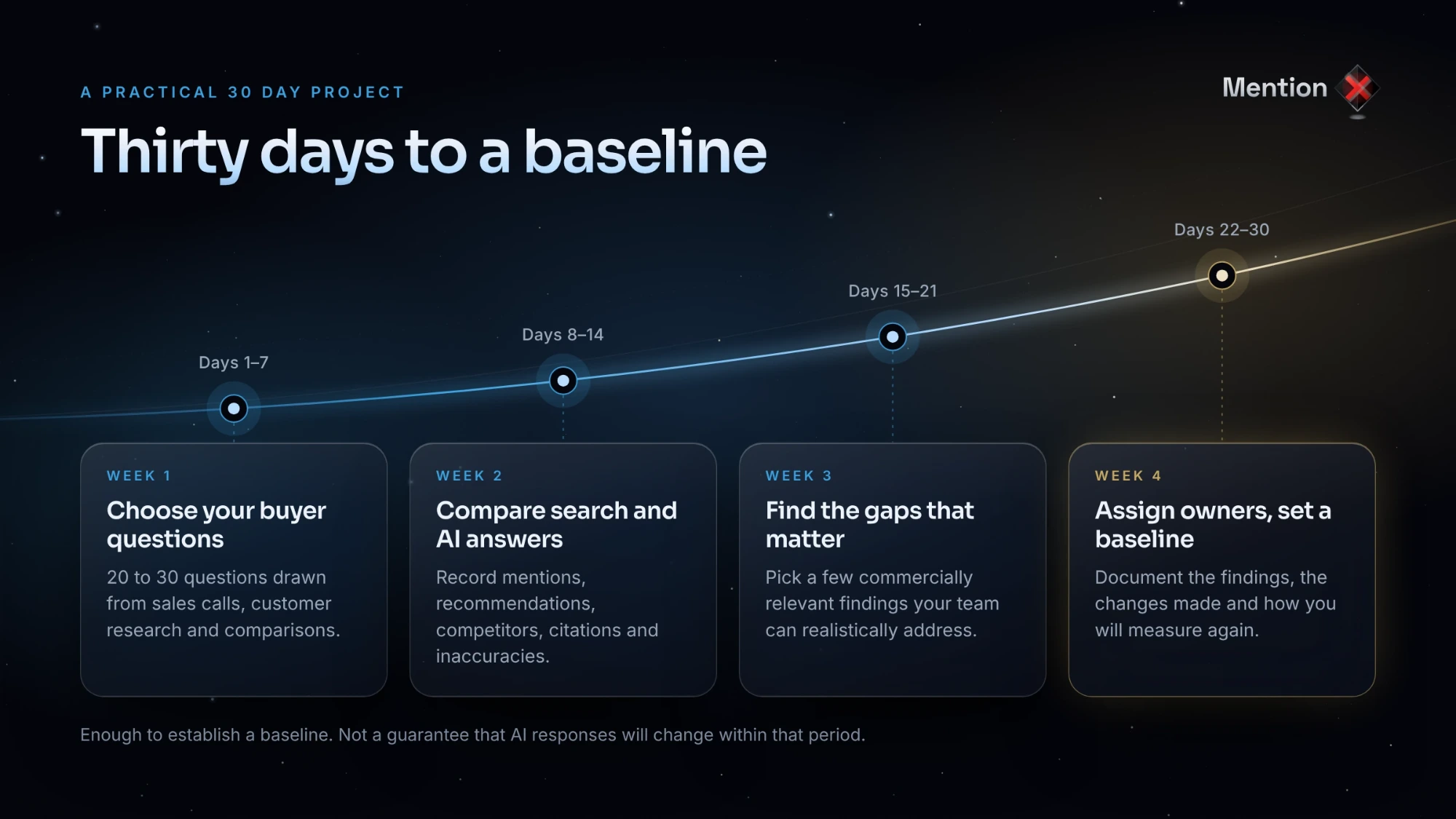
Start with 20 to 30 questions that reflect your product category, customer requirements, and commercial priorities.
Use sales conversations, customer research, and frequently asked comparison questions rather than relying exclusively on SEO keywords.
Include unbranded discovery questions and relevant competitor comparisons.
Identify the important pages and search queries associated with those subjects.
Then review how relevant AI platforms answer the corresponding buyer questions.
Record mentions, recommendations, competitors, source citations, and factual inaccuracies.
Preserve the actual responses and repeat important prompts where practical, since AI outputs can vary.
Look for a small number of commercially relevant findings.
Perhaps your integration page lacks detail.
Perhaps a product comparison is outdated.
Perhaps AI systems repeatedly misunderstand your target audience.
Or perhaps a competitor is consistently described as stronger in an area where your company has credible evidence to offer.
Prioritize problems that your team can realistically address.
Give each opportunity an owner.
Your SEO team might improve technical access or an existing page. Product marketing might clarify positioning. Customer marketing could strengthen an incomplete case study. PR might investigate relevant independent coverage.
Document the original findings, the changes made, and how you intend to measure them again.
Four weeks is enough to establish a useful baseline and begin addressing problems. It is not a guarantee that AI responses will change within that period.

Not necessarily.
For many organizations, the first step should be extending existing SEO, content, analytics, and product marketing activities.
A separate investment becomes easier to justify when the team can demonstrate that important buyer questions are being answered in ways that consistently underrepresent or misdescribe the company.
Even then, investment should be based on commercial relevance.
A missing mention in an obscure question may be less important than a well performing comparison page that generates qualified pipeline.
Marketing leaders should also avoid promises of guaranteed recommendations.
AI platforms change, retrieval varies, and no outside vendor controls every generated response.
The best justification for investment is a repeatable process that identifies meaningful gaps, supports credible improvements, and measures subsequent results.
No. SEO measures and improves search discoverability and performance. AI visibility examines how brands and information appear in AI generated responses. They overlap, and strong SEO fundamentals remain valuable.
Yes. Search rankings do not guarantee that an AI assistant will mention or recommend a brand for a particular buyer question.
Yes. Platforms such as Ahrefs and Semrush now provide dedicated AI visibility features. However, traditional SEO metrics alone do not explain brand recommendations, citations, or competitive presence across AI platforms.
A monthly review is a practical starting point for many teams. More frequent monitoring can be useful during major launches, positioning changes, or competitive campaigns. The right frequency depends on your market and how the data will be used.
It may contribute to better discovery and consideration, but increased visibility does not guarantee revenue growth. Commercial impact should be investigated through analytics, customer research, and CRM data alongside the visibility measurements.
SEO remains one of the most useful ways to understand how people find your website.
AI visibility adds something traditional reporting doesn't fully explain: how your company is represented when buyers ask AI to help them understand a market or compare their options.
Neither tells the complete story alone.
Your search reports might show that your pages are reaching the right audience. AI visibility data might reveal that a competitor is being considered more frequently in certain buying situations.
Together, these findings can help your team ask better questions, identify information gaps, and decide where to invest.
That's the real shift.
Marketing isn't just about being found. It's also about understanding what buyers are being told before they decide whom to consider.
The goal isn't to replace SEO with another acronym.
It's to make sure your marketing decisions reflect how people actually discover, research, and evaluate companies today.
For marketers who want to move from measurement into implementation, these MentionX resources provide more detail:
MentionX helps marketing teams measure and understand how their brands appear across AI discovery platforms.
It tracks brand mentions, recommendations, competitive visibility, sentiment, and cited sources while preserving the underlying AI responses for review.
Rather than replacing SEO reporting, MentionX provides an additional layer of evidence about how AI systems represent your brand and competitors.
You can review the MentionX measurement methodology to understand how its metrics are defined and interpreted.