Insight · 12 min

How AI Search Is Changing B2B Buyer Journeys

Short answer

How evaluation committees research vendors inside AI answers.

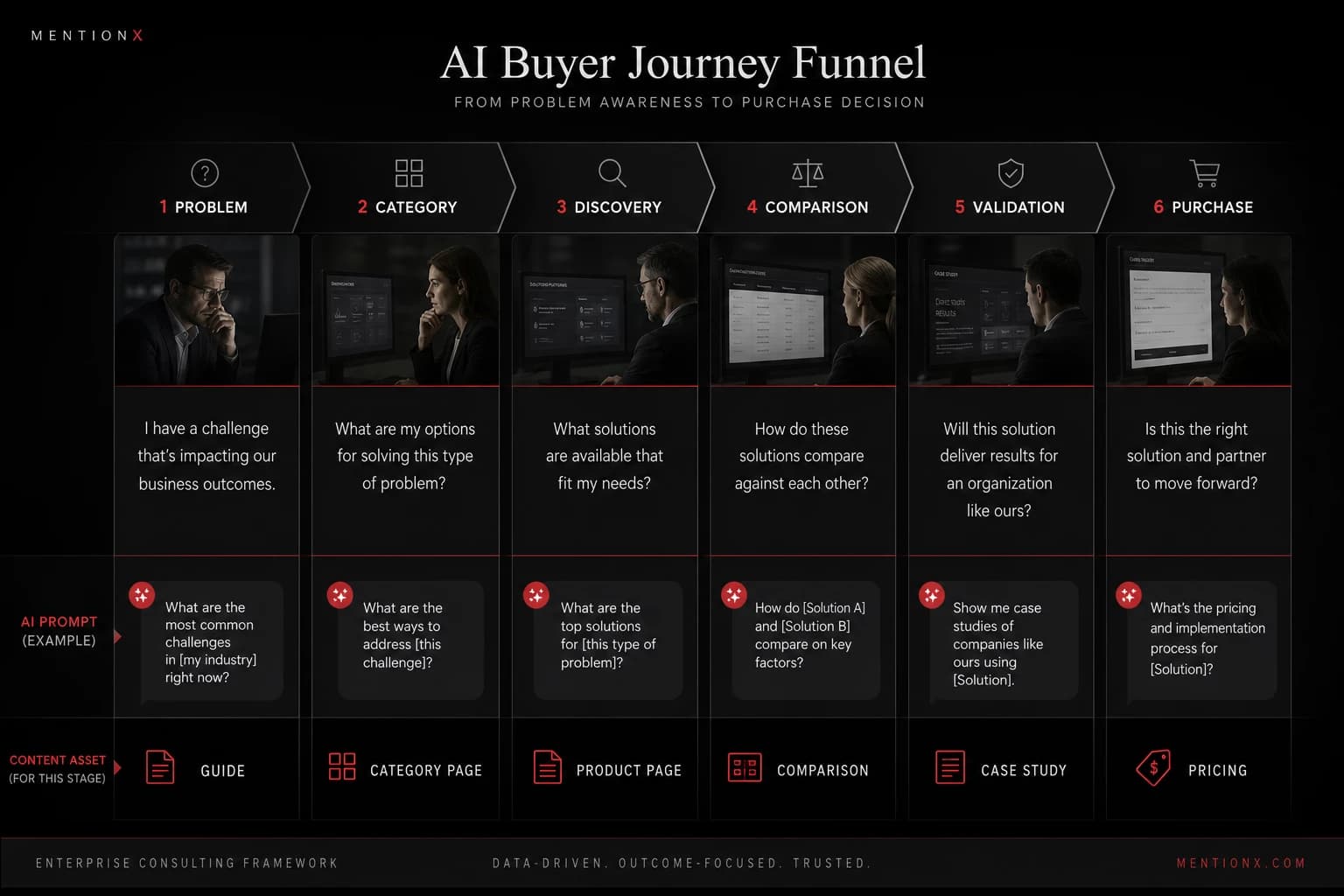
AI buyer journey funnel with content assets per stage
01

The new journey map

B2B discovery used to look like this: Google → vendor site → demo request.

It increasingly looks like this: ChatGPT → shortlist of three names → maybe visit one site → demo.

The consideration set is forming inside the answer. If AI never names you, your funnel never starts — regardless of SEO traffic.


Legacy B2B journey
  Problem aware → Google search → 10 blue links → 3 vendor sites → demo

AI-augmented journey (2026)
  Problem aware → AI prompt ("best X for Y") → 3–5 named vendors
                → selective site visit / review check → demo
                → (optional) Google to validate AI shortlist

Shift: AI moves vendor filtering earlier and reduces parallel evaluation. Buyers trust the answer as pre-filtered expert advice.


02

Stage-by-stage: what changed

1. Problem framing

Before: Buyer searches symptoms (“reduce churn in SaaS”).
Now: Buyer asks “What tools help mid-market SaaS reduce churn — compare options.”

AI bundles problem + category + recommendation in one step.

Marketing implication: Category definition and use-case language must match how buyers prompt, not only how you describe yourself on the homepage.

2. Longlist formation

Before: Longlist from SERP, analyst reports, peer asks.
Now: Longlist = names in the AI answer.

If the engine returns five vendors and you are not one, you are not on the longlist — full stop.

Measure: Mention rate on recommendation prompts (methodology).

3. Shortlist & comparison

Before: Comparison via spreadsheets, G2, sales calls.
Now: “Compare Vendor A vs Vendor B for 200-person team, SOC2 required.”

AI produces narrative comparison — often citing reviews and docs.

Measure: Position on comparison prompts + citation domains (G2, Reddit, your /compare/ pages).

4. Validation

Before: Deep site dive, security review, references.
Now: Buyer may validate AI’s shortlist with a quick Google or peer Slack — not a full re-research.

Implication: AI visibility and SEO visibility reinforce each other here. Weak AI + weak SEO = invisible. Strong AI + weak site = demo risk.

5. Demo & procurement

AI rarely closes deals. It biases who gets the meeting.

Track: branded search lift, “I heard about you from ChatGPT” in CRM (qualitative), win rate vs competitors who dominate AI SOV.


03

Personas and prompt patterns

PersonaTypical AI prompt patternWhat they need from vendors
End-user champion“Best {tool} for {team size} doing {job}”Proof you fit workflow
Manager / director“Compare {A} vs {B} for {constraint}”Clear differentiation
IT / security“{Vendor} SOC2 / SSO / EU data residency”Trust & compliance citations
Finance / ops“Pricing for {category} tools — mid-market”Transparent pricing pages engines can cite
Executive sponsor“Market leaders in {category} 2026”Category leadership signals

Build your prompt library from sales discovery calls — not from keyword tools alone.


04

Why traditional funnel metrics lag

MetricLag problem
Organic trafficBuyer may never click before shortlisting
Form fillsOnly sees survivors of AI filter
Branded searchUptake after AI mention — trailing indicator
Content downloadsMid-funnel; misses AI exclusion

Add leading indicators:

  • AI mention rate on category prompts
  • AI share of voice vs top 3 competitors
  • Citation share from review & community domains
  • Delta month-over-month on fixed prompt set

05

Category dynamics in B2B SaaS

Incumbent advantage

Models overweight famous category leaders in recommendation prompts — even when challengers have better fit.

Challenger strategy: Win niche prompts (“best X for healthcare mid-market”) before broad “best X” prompts. Measure SOV per topic cluster.

Comparison-page economy

B2B buyers prompt comparisons by name. If /compare/competitor pages do not exist, engines synthesize from third-party comparisons — where you do not control narrative.

Action: Owned, factual comparison pages (see GEO guide).

Community & review gravity

Reddit, G2, and niche Slack archives appear repeatedly as citation sources in B2B AI answers.

Action: Citation gap analysis — which domains cite competitors but not you?


06

How MentionX measures this

MentionX mirrors the buyer journey in software:

  1. Discovery from your URL → category & competitors
  2. Buyer prompts (recommendation, comparison, alternative)
  3. Multi-engine execution → stored evidence
  4. Mention rate, position, SOV, citations
  5. Monitoring over time (Nova+)

Built for B2B teams who need audit trails, not vanity scores.

→ AI Visibility for B2B SaaS


07

90-day playbook for B2B marketing leaders

Days 1–14 — Baseline
Run 30 buyer prompts from sales transcripts. Score mentions & citations per engine.

Days 15–45 — Gap closure
Top 3 citation gaps + top 3 comparison prompts where you rank poorly.

Days 46–75 — Proof content
Publish comparison pages, update review profiles, seed cite-worthy data.

Days 76–90 — Re-scan & report
Show SOV delta to leadership. Tie to pipeline qual conversations.

Checklist: AI Search Optimization Checklist


08

FAQ

Will AI replace sales-led B2B?
No for enterprise ACV. Yes for who gets considered at mid-market and PLG.

Should we train sales on AI visibility?
Yes — reps should know if prospects hear competitors named in AI before the call.

How does this affect ABM?
ABM accounts may research via AI before engaging. Track visibility on account-relevant use-case prompts.